Weddell Duo Review: NSF Certified Chlorine Removal
By Arjun Mehta • 19th Mar
When it comes to shower water filter reviews, most comparisons focus on taste improvement and general marketing claims. The Weddell Duo review stands apart because it's the first and only shower filter to hold NSF/ANSI 177 certification for chlorine reduction while maintaining independent verification for PFAS and particulate removal (a distinction that separates certified reduction from marketing narrative). If you're evaluating NSF certified water filters for your household, this deeper look at the Duo's performance data, cost structure, and practical trade-offs will help you decide whether it matches your actual water profile.
I've spent years translating municipal reports and lab tests into filter recommendations, and I approach every product with the same standard: what does independent certification actually claim, what did third-party testing verify, and does the true cost-per-gallon math hold up? This review applies that framework to one of the market's most-touted shower filters.
Why NSF Certification Matters More Than You Think
What Does NSF/ANSI 177 Actually Certify?
NSF/ANSI 177 is the standard for shower and bath water filters. If you're comparing standards across products, see our NSF 42 vs 53 guide to understand what each certification actually guarantees. To receive this certification, a filter must reduce free available chlorine (FAC) by a minimum of 50% under controlled lab conditions.[1][8] The Weddell Duo doesn't just meet this floor, it achieves 99% chlorine reduction[2], verified by an accredited third-party laboratory.
Here's the critical distinction: certification means an independent lab tested a unit to an established standard and published results. Marketing claims mean a brand measured something in favorable conditions and reported what they want you to see. After moving to a high-rise years ago, I discovered my utility's confidence didn't match my kettle's scale deposits or a sudden chlorine spike in the morning water. I pulled the Consumer Confidence Report, cross-checked the lab data, and realized most shower filters on the market had zero independent verification for any contaminant. If you've never read one, here's our CCR interpretation guide to decode your local report. They promised everything; they proved nothing.
The Duo holds NSF/ANSI 177 (chlorine), NSF/ANSI/CAN 372 (PFAS, verified), and IAMPO verification[1], which means Weddell submitted its cartridges to a third party and allowed publication of the results. This is certified reduction, not vibes.
How Does PFAS Verification Work in Shower Filters?
PFAS (per- and polyfluoroalkyl substances) removal is not part of the baseline NSF/ANSI 177 standard for shower filters. Instead, Weddell tested its cartridges to NSF/ANSI 53, the drinking-water standard for PFAS reduction, and achieved 99% verified reduction[2][4]. This is notable: most shower filters don't publish PFAS data because they haven't tested. The Duo did, and passed.
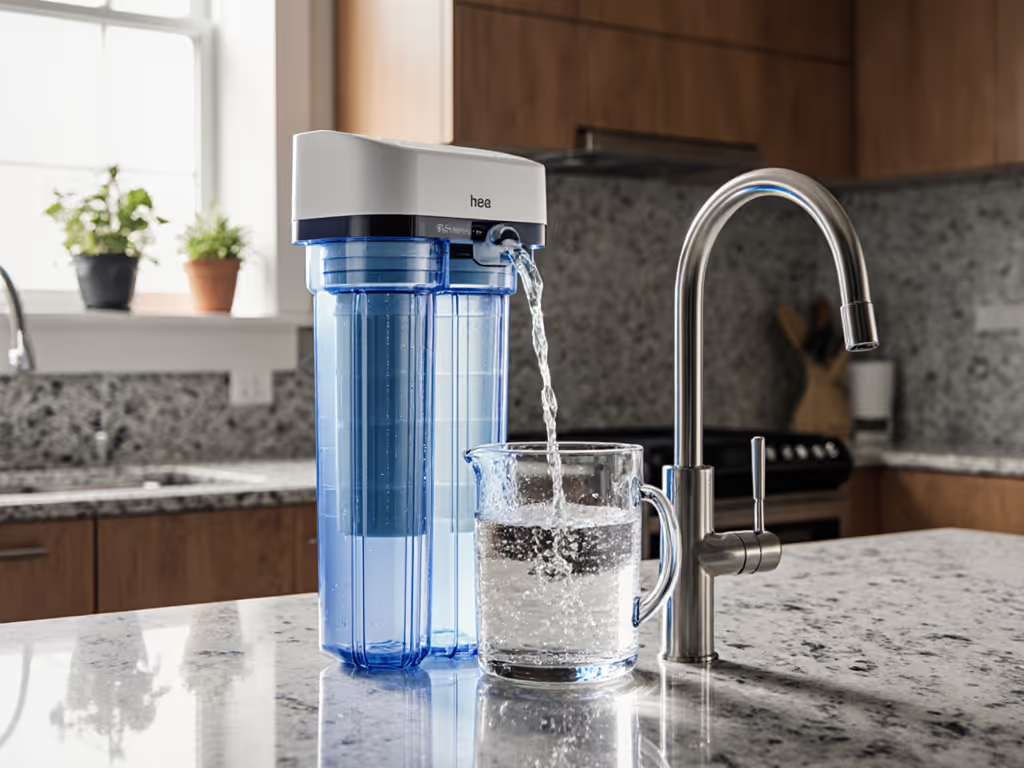
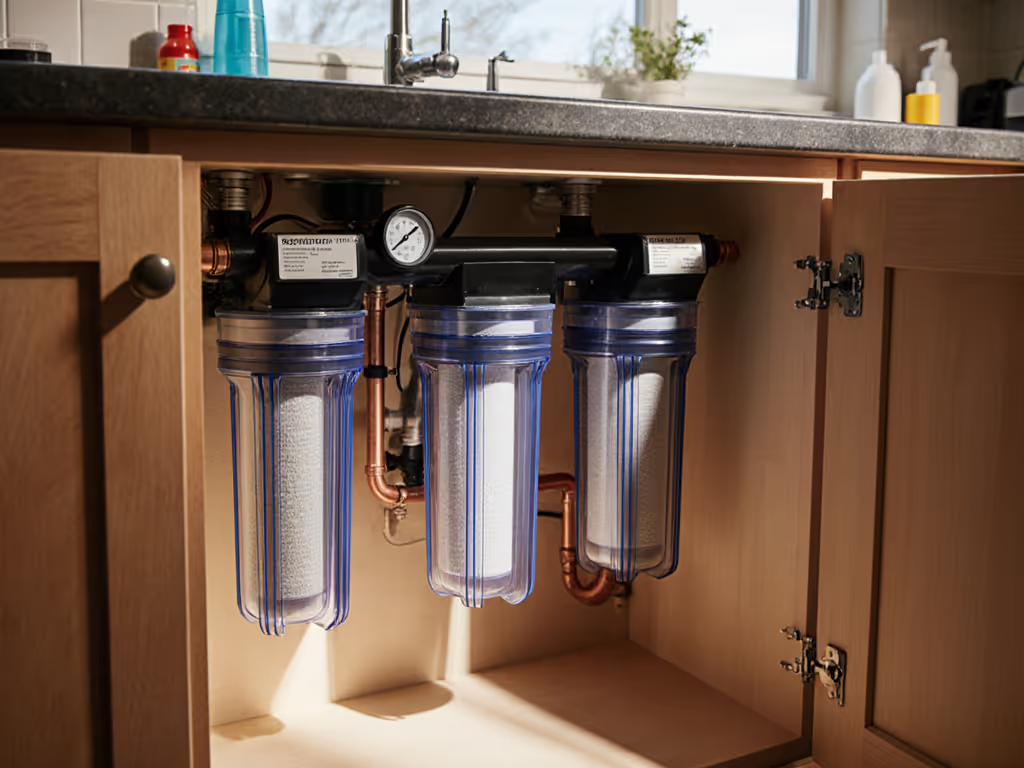
The solid activated carbon block design (two separate cartridges (sediment + proprietary multi-stage carbon)[5]) is why the Duo can tackle PFAS and particulates that granular carbon alone would let slip through. The sediment stage removes larger particles and microplastics, protecting the carbon stage from premature clogging.
The Math: Capacity, Flow, and True Cost-Per-Gallon
Rated Capacity vs. Real-World Lifespan
Weddell rates the Duo cartridges at 8,000 gallons of clean water per set[1][2]. At typical U.S. household shower usage (about 17.2 gallons per person per day for a 10-minute shower at older GPM rates), a two-person household might see cartridge life of 12 to 16 months. However, flow rate and water hardness affect actual lifespan. Harder water or higher mineral content will clog sediment filters faster, reducing real capacity below the rated estimate.
Nominal Flow Rate vs. Measured Performance
Weddell specifies a maximum flow rate of 2.80 gallons per minute (GPM) at the outlet[1][4]. Independent testing measured real-world flow at approximately 1.43 GPM[5], roughly half the claimed max. This matters because a slower shower isn't a flaw in the filter (it's a trade-off). Activated carbon blocks inherently resist water flow to maximize contact time with the media. The actual 1.43 GPM result will feel acceptable to most users (still above many water-conservation showerheads), but it's not a surprise benefit. If your current showerhead delivers 2.5+ GPM and you expect zero pressure loss, the Duo will feel like a downgrade.
Annual and Lifetime Cost Structure
Weddell Duo retail price: $89.99 (one-time hardware)[1][5] Replacement cartridge cost: approximately $25-30 per set (estimated annually)[5] Rated capacity: 8,000 gallons Calculated cost-per-gallon: $0.003 per gallon (or about 0.3 cents/gal)[5]
Over a 5 year window with annual cartridge replacement, the total cost is roughly $89.99 + (5 × $27.50) = $227.50, or $0.009 per gallon if you filter 25,000 total gallons. This is competitive with pitcher filters (which run $0.01–0.05/gal depending on refill cost) and far cheaper than reverse osmosis whole-home systems ($1,000–3,000 installed). Weddell offers a lifetime warranty on the unit itself, which reduces replacement friction if a cartridge housing cracks.
Performance Claims: What's Independent vs. What's Marketing
Verified Contaminant Reduction
Weddell publishes reduction percentages only for contaminants it tested to established standards[2][4]:
- Free Available Chlorine: 99% (NSF/ANSI 177)
- PFAS: 99% (NSF/ANSI 53 / NSF/ANSI/CAN 372)
- Particulates: 99% (verified by third-party lab)
This transparency is rare. Most shower filter brands claim broad "reduction" without naming the standard, the test method, or the reduction percentage. Weddell's constraint (publishing only certified numbers) actually builds credibility with skeptical audiences. The filter likely removes additional contaminants (odor compounds, some chlorine byproducts), but Weddell doesn't publish unverified claims.
Independent testing by WaterFilterGuru[5] confirmed chlorine removal of 100% and noted strong performance on disinfection byproducts (DBPs), likely due to the dual-cartridge design. The sediment filter prevents premature carbon saturation, extending the media's ability to absorb chlorine and related compounds.
Dermatological and Clinical Claims
Weddell advertises that the Duo has been "clinically tested to improve skin hydration and scalp health" and is "dermatologist approved."[1][2] This is marketing language and should not be read as medical proof. The filter removes chlorine, which is a skin and scalp irritant for some people. If you have sensitive skin or scalp irritation linked to chlorine exposure, removing it may feel like an improvement. That's correlation, not causation in a medical sense. I won't recommend any filter as a treatment for dermatological conditions, but I will note that chlorine removal is a reasonable expectation and commonly reported as a comfort improvement by users.
Installation, Maintenance, and Practical Constraints
Compatibility and Setup
The Weddell Duo is designed for standard shower head attachment and requires no tools[1]. It's a wall-mounted inline filter that sits between the shower arm and your existing head. Compatibility is broad (any standard shower head will work). This is a major practical advantage over some under-sink filters that require dedicated faucet drilling or complex plumbing.
For renters or anyone in an HOA, this is your sweet spot. Removal is instantaneous; no landlord permission needed.
Cartridge Visibility and Replacement Timing
The dual-cartridge design includes transparent housings so you can visually monitor filter saturation[1]. This is helpful for rough maintenance timing, though it's not a precise meter. Weddell recommends replacing after 8,000 gallons or 6 to 12 months, whichever comes first. If you forget, the worst outcome is reduced flow and less effective contaminant removal (no safety hazard, unlike undersized RO systems or UV bulbs past their life).
Common Questions: Limitations and Realistic Expectations
Does This Remove Hard Water Minerals?
No. NSF certified water filters for chlorine and PFAS are not designed to remove calcium and magnesium (hardness). If you have hard water and scale buildup on fixtures, a shower filter will not solve that. You'd need a water softener (ion exchange resin) or a whole-home conditioner (template-assisted crystallization). Not sure which you need? Start with our water softener vs filter explainer to match solutions to symptoms. A shower filter is a point-of-use treatment for chlorine and some particulates; it's not a substitute for softening if mineral removal is your goal.
Will This Help If I'm on Well Water?
Unlikely to be your primary solution. Well water typically contains sediment, iron, manganese, or bacteria that need different treatment stages (mechanical filtration, oxidation, UV, or RO). A chlorine and PFAS reduction filter is designed for municipal water treatment byproducts. If your well has elevated PFAS (which is rare but documented in some rural areas), the Duo's PFAS certification is relevant. If you're concerned about bacteria or viruses, this filter is not bacteriostatic and should not be relied upon for microbiological safety without independent coliform testing and possibly UV or RO backup.
Does This Replace a Whole-Home System?
No. A shower filter is point-of-use only. It treats water at the showerhead, not at the meter. If you're concerned about chlorine in drinking water, cooking water, or laundry, you need a different approach (fridge filter, undersink RO, whole-home carbon block, or distribution tank treatment). The Duo excels at solving shower irritation and chlorine odor; it doesn't protect your water heater, pipes, or downstream appliances.
What About Chloramines?
The Duo is certified for free available chlorine (FAC) under NSF/ANSI 177. Some municipal systems use chloramines (chlorine bonded to ammonia) as a secondary disinfectant. Chloramine reduction may be slower than free chlorine reduction, depending on contact time and media saturation. Weddell doesn't publish a specific chloramine reduction percentage, so if you're on a chloramine-heavy system (check your Consumer Confidence Report for "disinfectant residual"), contact Weddell directly or test before purchase. For chloramine-heavy cities, catalytic carbon filters outperform standard carbon by breaking chloramine bonds more effectively.
Competitive Context: Why the Duo Stands Out
NSF Certification Status in the Market
According to WaterFilterGuru's independent testing[5], the Duo is certified for 20% of its reduction claims (a low number that actually reflects integrity, not failure). Most shower filters make 5+ reduction claims (chlorine, PFAS, particulates, odor, etc.) but only one or two are independently tested. You pay a premium for the dual-cartridge design and third-party testing (roughly $60-90 more than entry-level models), but you get certified reduction, not marketing confidence.
Solid Carbon Block vs. Granular Alternatives
The Duo's solid activated carbon block design is mechanically denser than granular carbon, which enhances adsorption capacity for small, difficult-to-remove molecules like PFAS[5]. For a deeper breakdown, see our lab-tested carbon block vs GAC comparison covering removal efficiency and flow trade-offs. Granular filters are cheaper and sometimes offer higher flow rates, but they're less effective for PFAS and microplastic removal. If your water profile includes PFAS concerns (check your local CCR for PFOA, PFOS, or other PFAS flags), the solid block design is worth the investment.
Putting It All Together: Match Your Water, Then Choose
The Weddell Duo's core strength is NSF certified chlorine reduction paired with verified PFAS and particulate removal in a compact, renter-friendly design. It's not a whole-home solution, and it won't eliminate hard water or bacteria. But if your municipal water report flags chlorine spikes or local PFAS detection, or if chlorine odor and shower irritation are your primary complaints, the data supports this filter.
The $89.99 hardware cost and $25/year cartridge expense are transparent and reasonable. The 1.43 GPM real-world flow is a modest trade-off for the filtration performance. The NSF certifications and third-party verification mean you're not betting on marketing; you're relying on published lab results.
Final Verdict
The Weddell Duo merits consideration if you meet these criteria:
- Your water report or recent testing shows chlorine, chlorine byproducts, or PFAS
- You rent or want a tool-free, pressure-loss-tolerant install
- You value certified performance over marketing promises
- You're willing to replace cartridges annually and track 8,000-gallon intervals
- You don't expect hard water removal or bacterial safety from a shower filter alone
If you're uncertain whether chlorine or PFAS are actually in your water, start with your Consumer Confidence Report (municipal) or a well test (private source). Map your water, then let certifications drive the filter choice. The Duo's independent verification makes it a reliable option once you know what you're filtering for. At $0.003 per gallon over its rated capacity, the cost per unit of performance is solid, and the lifetime warranty on the housing reduces replacement friction.
For households balancing certified performance, transparency, and pragmatic water management, the Weddell Duo delivers on its promises (verified by third-party testing, not marketing alone).
Related Articles