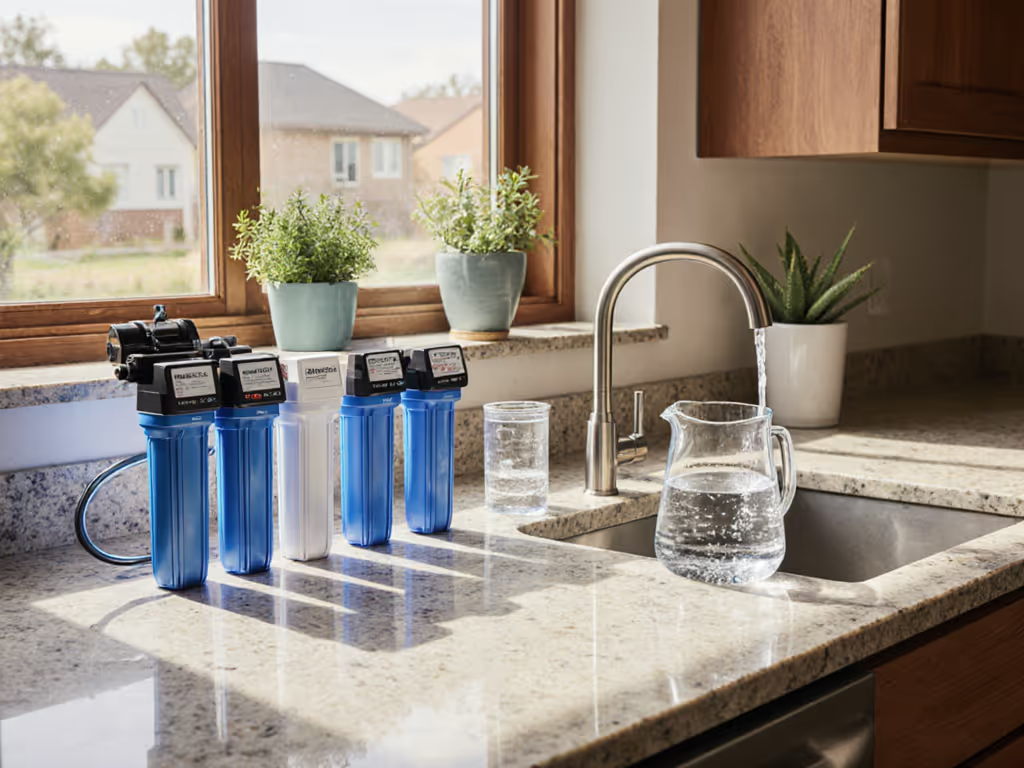
November 9, 2025: The Ultimate Checklist to Choose a Certified, Low-Waste Home Water Filter
By Lina Petrov • 9th Nov
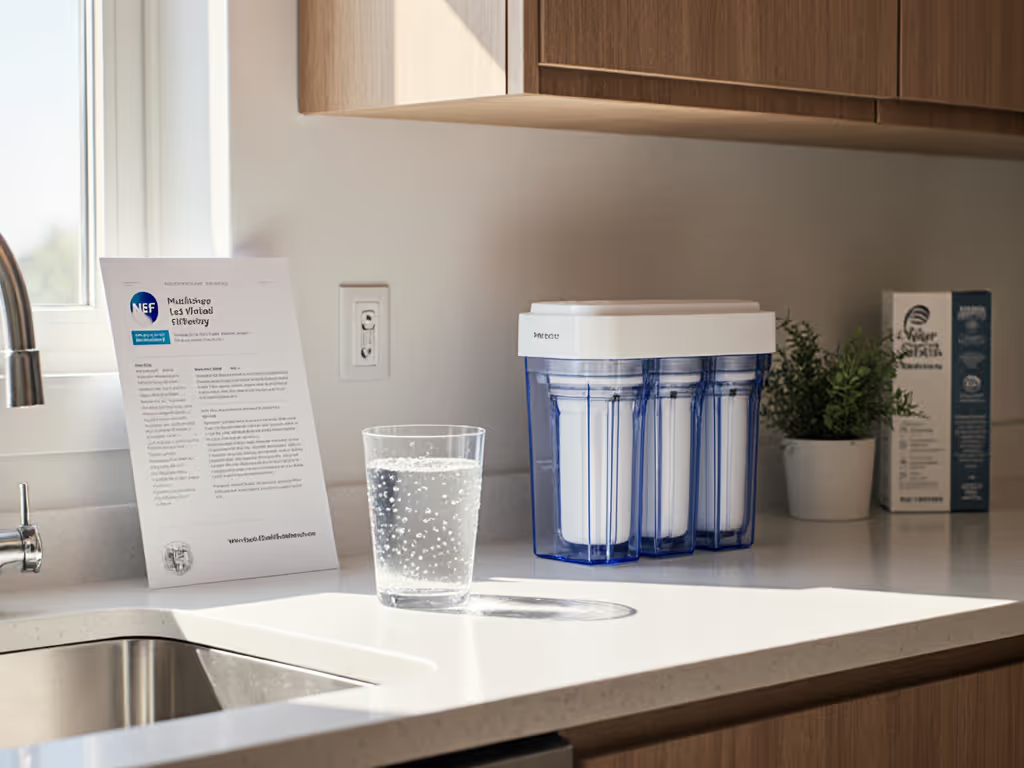
If you want a water filter that truly works and does not create a pile of plastic, you need a plan, not guesses. This blog post for 2025-11-09 walks you through a rigorous, practical checklist so you can match real contaminants with verified performance while controlling long-term costs and waste. Along the way, you will learn how to decode National Sanitation Foundation/American National Standards Institute (NSF/ANSI) certifications, compare filter types fairly, and build a maintenance schedule you will actually keep. Clean Water, Less Waste provides the tools, data, and personalized guidance to make your next choice confident rather than confusing.
Start Here: blog post for 2025-11-09 Checklist Foundations
Choosing a filter begins with clarity about your goals and constraints, because the right solution for a downtown apartment may be wrong for a rural well. First, decide which outcomes matter most: removing specific contaminants like lead and per- and polyfluoroalkyl substances (PFAS), improving taste and odor, preventing microbial risk, or softening water for appliances. Second, define your installation limits and lifestyle, including under-sink space, countertop access, or whole-home plumbing changes, plus your tolerance for flow reduction or remineralization steps. Finally, consider sustainability: cartridge mass over three years, water waste from technologies like reverse osmosis (RO) (reverse osmosis), and packaging, because the lowest sticker price can hide the highest lifetime footprint.
As a rule of thumb, performance without certification is a promise, not proof. This is where National Sanitation Foundation/American National Standards Institute (NSF/ANSI) standards come in, because they codify contaminant reduction tests, capacities, and material safety. However, not all standards mean the same thing; for instance, National Sanitation Foundation/American National Standards Institute 42 is about taste and odor, while National Sanitation Foundation/American National Standards Institute 53 targets health claims such as lead. For a deeper breakdown of what each label guarantees, see our NSF 42 vs 53 guide and how to apply it to your shortlist. Clean Water, Less Waste leans on certification-based data to rank filters by verified reduction, not marketing, and pairs those results with personalized recommendations that factor in capacity, maintenance cadence, and long-term waste.
Know Your Water: Municipal vs. Well, Seasonal Shifts, and What to Test
Your water source shapes everything. If you are on a public system, you receive a Consumer Confidence Report from your utility and can cross-check typical concerns like chlorine, chloramine, disinfection byproducts, lead from home plumbing, and emerging pollutants. Use our CCR interpretation guide to translate your report into specific filter requirements. If you use a private well, you are responsible for testing, and the United States Environmental Protection Agency (EPA) (Environmental Protection Agency) suggests annual checks for bacteria and nitrates, with periodic testing for arsenic, manganese, and other region-specific risks. Approximately 13 million U.S. households rely on private wells, and a 2023 study by the United States Geological Survey (USGS) (United States Geological Survey) estimated that about 45 percent of sampled taps contained at least one PFAS (per- and polyfluoroalkyl substances), illustrating why a one-size-fits-all approach fails.
Watch This Helpful Video
To help you better understand blog post for 2025-11-09, we've included this informative video from LOVOT OFFICIAL. It provides valuable insights and visual demonstrations that complement the written content.
Because contaminant profiles change, re-test during life events and after infrastructure updates. For example, seasonal runoff can raise turbidity and agricultural nitrate, construction can disturb lead scales, and drought can concentrate salts and minerals. A practical path is to pair a lab kit for your dominant risks with targeted on-site meters for pH, hardness, and total dissolved solids. Clean Water, Less Waste offers guides for various water sources, including well water, that map test results to certification-backed filter options. If you want a visual cue, imagine a simple decision tree: confirm your source, test for probable contaminants, choose the matching National Sanitation Foundation/American National Standards Institute (NSF/ANSI) standard, then select the lowest-waste device that meets your reduction goals.
- Municipal water: focus on chlorine, chloramine, lead, copper, disinfection byproducts, and PFAS (per- and polyfluoroalkyl substances).
- Private wells: prioritize bacteria, nitrates, iron/manganese, arsenic, hardness, and local industrial or agricultural contaminants.
- Trigger events: new baby, plumbing work, flood, nearby firefighting foam use, or taste changes warrant immediate testing.
Decode Certification: What NSF/ANSI Numbers Actually Mean
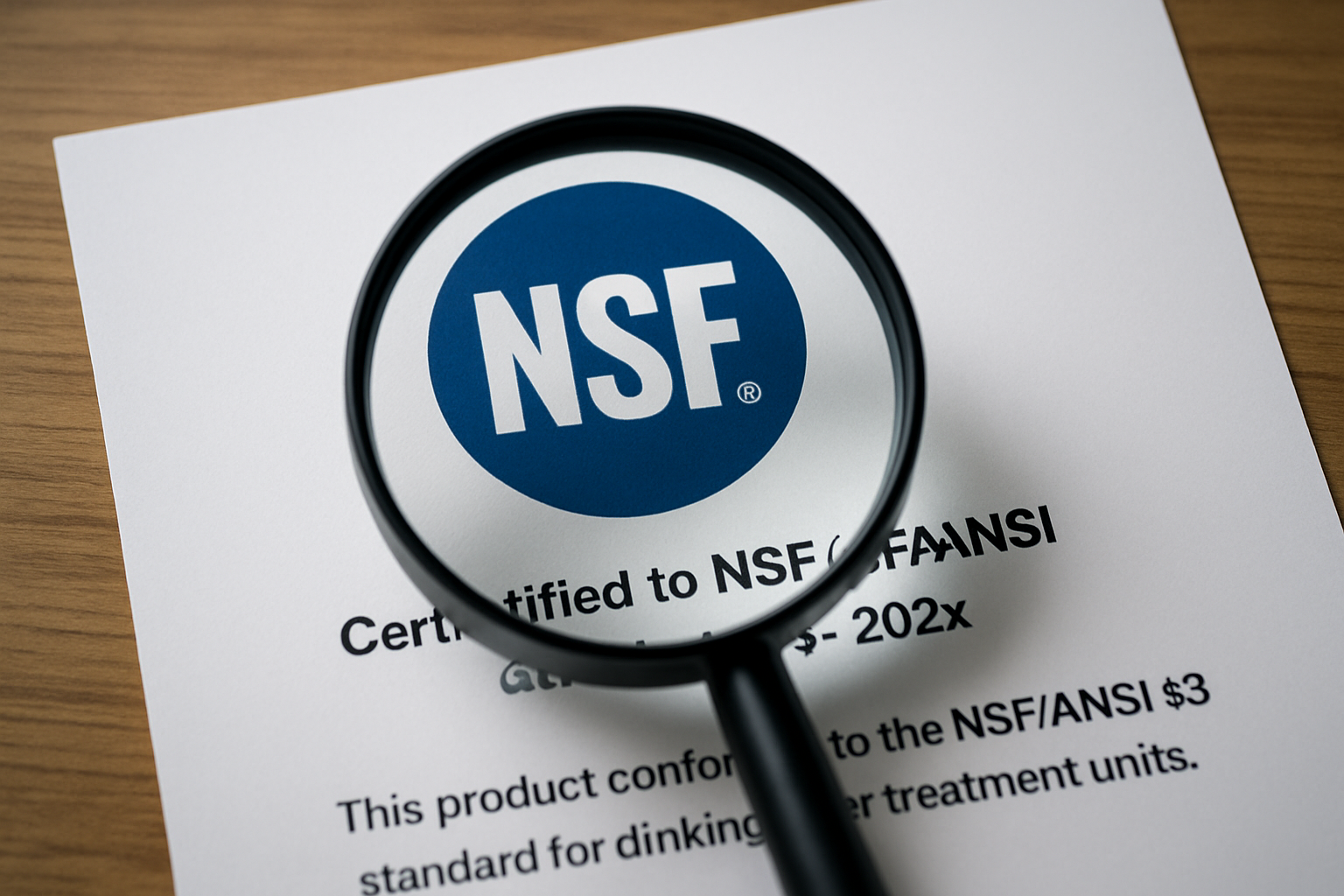
Certifications are the backbone of a trustworthy purchase, but jargon can blur understanding. Think of each National Sanitation Foundation/American National Standards Institute (NSF/ANSI) standard as a lens that focuses on a specific set of claims. National Sanitation Foundation/American National Standards Institute 42 covers aesthetic effects like chlorine, taste, and odor. National Sanitation Foundation/American National Standards Institute 53 addresses health-related contaminants such as lead, chromium-6, cysts, and certain volatile organic compounds. National Sanitation Foundation/American National Standards Institute 58 governs reverse osmosis (RO) (reverse osmosis) systems, including structural integrity, TDS reduction, and often PFAS (per- and polyfluoroalkyl substances) claims via additional protocols. National Sanitation Foundation/American National Standards Institute 401 targets emerging contaminants like pharmaceuticals and personal care products, while National Sanitation Foundation/American National Standards Institute P231 validates microbial purifiers for bacteria, viruses, and protozoa under rigorous challenge conditions.
Two nuances matter for buyers. First, products can be certified for some contaminants and not others under the same standard, so you must read the exact contaminant reduction claims, capacities, and flow rates. Second, National Sanitation Foundation/American National Standards Institute (NSF/ANSI) 372 is about lead-free materials, not lead reduction performance in water, and National Sanitation Foundation/American National Standards Institute 55 deals with ultraviolet (UV) (ultraviolet) disinfection classes for microbiological control. Clean Water, Less Waste publishes certified product reviews with the precise National Sanitation Foundation/American National Standards Institute (NSF/ANSI) claim sheets, translating standards into plain language and comparing capacity, replacement cadence, and waste so you are not left reading lab reports at midnight.
Key National Sanitation Foundation/American National Standards Institute (NSF/ANSI) Standards at a Glance
| Standard | Scope | Typical Verified Claims | Best Use Cases | Notes |
|---|---|---|---|---|
| NSF/ANSI 42 (National Sanitation Foundation/American National Standards Institute 42) | Aesthetic effects | Chlorine, taste, odor, particulate classes | Improving flavor on municipal water | Not health-risk reductions by itself |
| NSF/ANSI 53 (National Sanitation Foundation/American National Standards Institute 53) | Health effects | Lead, cysts, certain metals and volatile organic compounds | High-priority contaminant reduction | Check exact contaminant list and capacity |
| NSF/ANSI 58 (National Sanitation Foundation/American National Standards Institute 58) | Reverse osmosis (RO) (reverse osmosis) | Structural integrity, total dissolved solids reduction, often PFAS with protocols | Broad reduction on challenging water | Evaluate waste ratio and remineralization needs |
| NSF/ANSI 401 (National Sanitation Foundation/American National Standards Institute 401) | Emerging contaminants | Pharmaceuticals, herbicides, personal care products | Municipal water with trace contaminants | Complements, not replaces, 53 or 58 |
| NSF/ANSI P231 (National Sanitation Foundation/American National Standards Institute P231) | Microbiological purifiers | Viruses, bacteria, protozoa | Travel, boil advisories, untreated sources | Often combined with prefiltration |
| NSF/ANSI 55 (National Sanitation Foundation/American National Standards Institute 55) | Ultraviolet (UV) (ultraviolet) systems | Class A/B microbiological treatment | Private wells, post-filtration disinfection | Needs clear water and power |
| NSF/ANSI 372 (National Sanitation Foundation/American National Standards Institute 372) | Lead-free materials | Material safety, not reduction | All devices that contact drinking water | Pair with 53 for lead in water |
Filter Types, Coverage, and Waste Footprint
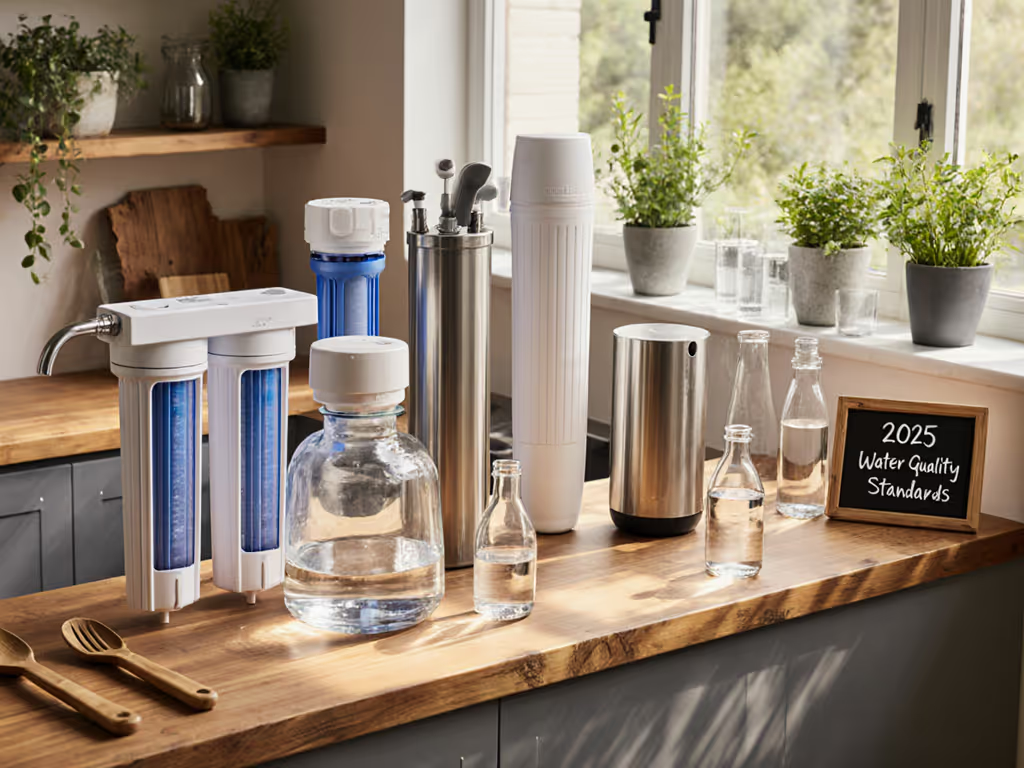
Every filter design is a trade-off among coverage, flow, convenience, and environmental impact. Granular activated carbon (GAC) (granular activated carbon) pitchers excel at quick chlorine and taste fixes with modest waste, yet they often lack robust lead or PFAS (per- and polyfluoroalkyl substances) claims unless paired with advanced carbon or ion exchange media validated under National Sanitation Foundation/American National Standards Institute 53 or 401. Under-sink carbon block systems deliver higher contact time and capacities, making certified lead and volatile organic compound reduction more achievable with a smaller cartridge footprint per gallon. Reverse osmosis (RO) (reverse osmosis) adds a membrane barrier for broad contaminant reduction, but you must evaluate concentrate-to-permeate ratios and the opportunity to reuse concentrate for non-potable needs, as modern systems can reach near 1:1 ratios. If RO is on your shortlist, read our NSF 58 explained to know which claims and waste ratios actually matter.
Whole-home systems are best for distribution-wide targets like chlorine, sediment, and scale, but health contaminants you drink should still be addressed at the tap for certainty. Ultraviolet (UV) (ultraviolet) disinfection neutralizes microbes effectively when water is low in turbidity, often used on private wells after sediment and carbon filtration. For sustainability, look at cartridge mass per gallon, packaging, and manufacturer take-back programs. Clean Water, Less Waste compares filters not just on verified reduction, but also on capacity, replacement intervals, and three-year waste, making it easier to choose an option that respects your values and your budget.
Common Filter Types Compared on Performance and Waste
| Type | Typical Certified Coverage | Waste Footprint | Capacity Range | Maintenance | Notes |
|---|---|---|---|---|---|
| Pitcher with GAC (granular activated carbon) | NSF/ANSI 42 (National Sanitation Foundation/American National Standards Institute 42), some 53/401 | Low cartridge mass, frequent replacements | 40 to 160 gallons | 2 to 8 weeks | Check for certified lead/PFAS claims, flow can slow over time |
| Faucet-mount carbon | Often 42 and select 53 | Low to moderate; compact cartridges | 100 to 200 gallons | 1 to 3 months | Convenient, may reduce flow and crowd faucet |
| Under-sink carbon block | Commonly 42, 53, and some 401 | Moderate; higher capacity per cartridge | 500 to 2000 gallons | 6 to 12 months | Strong lead and volatile organic compound performance when certified |
| Reverse osmosis (RO) (reverse osmosis) under-sink | 58 plus pre/post filters with 53/401 claims | Water concentrate waste; cartridges every 6 to 12 months; membrane 2 to 5 years | Varies by tankless vs tank and membrane | Filter changes 1 to 2 times per year | Broad reduction including salts and PFAS; evaluate 1:1 to 3:1 waste ratio |
| Whole-home carbon | Typically 42; sometimes 53 for specific claims | Low cartridge waste; media tanks last years | 50,000+ gallons | Media change every 3 to 5 years | Best for taste, odor, chlorine; still add drinking-water treatment |
| Ultraviolet (UV) (ultraviolet) disinfection | 55 Class A/B for microbes | Lamp replacement yearly; no water waste | N/A | Annual lamp and quartz sleeve maintenance | Requires clear water; often paired with sediment and carbon filters |
Total Cost, Maintenance, and Waste: A Three-Year View
Sticker price is only the first line on your ledger, because cartridges, membranes, lamps, and water waste add up. Compare expected dollars per gallon with our smart savings guide before you commit. Imagine two households: one chooses an under-sink carbon block with National Sanitation Foundation/American National Standards Institute 53 lead certification, 1000-gallon capacity, and 6-month changes at 40 dollars per cartridge; over three years, that is roughly 240 dollars in media and perhaps one housing O-ring. Another opts for reverse osmosis (RO) (reverse osmosis) with National Sanitation Foundation/American National Standards Institute 58, using two pre-filters and one post-filter annually for 80 dollars total, plus a membrane at year three for 60 dollars; if the system averages a 2:1 concentrate-to-purified ratio and you drink and cook 2 gallons daily, the water loss is about 4 gallons a day, which can be repurposed for plants or cleaning to minimize waste.
Waste footprint deserves equal attention. A single countertop pitcher may generate 10 to 20 small cartridges per year, while an under-sink carbon block might use two larger cartridges in the same period for the same volume. Some manufacturers offer mail-back recycling programs or design cartridges with less plastic, which can shrink total solid waste by 30 percent or more. Clean Water, Less Waste evaluates not only dollars per gallon, but also grams of cartridge waste per gallon and the presence of take-back or refill programs, helping you compare apples to apples. When you align maintenance with your calendar, such as filter changes every tax quarter, you protect performance without surprise expenses, and you keep waste predictable and low. For upkeep tips and common fixes, bookmark our water filter troubleshooting guide.
The Ultimate 12-Point Checklist for a Certified, Low-Waste Purchase

Use this checklist as your step-by-step short list. Print it, mark it up, and take it with you as you compare models online and in-store, because the fastest way to confidence is to verify each box with data rather than rely on brand promises.
- Confirm your source: municipal or private well, and note recent events like construction or flooding.
- Test for likely contaminants: lead, PFAS (per- and polyfluoroalkyl substances), nitrates, arsenic, bacteria, chlorine, and chloramine depending on source.
- Map each priority contaminant to the correct National Sanitation Foundation/American National Standards Institute (NSF/ANSI) standard: 42, 53, 58, 401, 55, or P231.
- Demand proof: look up the model’s certification listing and the exact contaminant reduction claims and capacities.
- Choose the smallest system that meets your goal to minimize waste, then confirm parts availability for at least five years.
- Estimate three-year costs and waste: cartridges, membranes, lamps, and if applicable, reverse osmosis (RO) (reverse osmosis) concentrate management.
- Check flow rate and space: under-sink clearance, faucet holes, whole-home plumbing access.
- Plan maintenance: calendar reminders, spare filters on hand, and a sanitation kit for housing cleanouts.
- For wells, include disinfection strategy such as ultraviolet (UV) (ultraviolet) or periodic shock chlorination as advised by a professional.
- If lead is a concern, prioritize National Sanitation Foundation/American National Standards Institute 53 for drinking taps and consider service line replacement with your utility.
- For PFAS, look for National Sanitation Foundation/American National Standards Institute 58 reverse osmosis (RO) (reverse osmosis) or 53/401 filters with explicit PFAS listings.
- Document your setup: model numbers, install date, test results, and next change date for quick troubleshooting.
Want examples of how this plays out? Consider an urban family in a 1950s home on municipal water with chloramine and possible lead. They choose an under-sink carbon block certified to National Sanitation Foundation/American National Standards Institute 53 for lead and National Sanitation Foundation/American National Standards Institute 42 for chlorine taste and odor, plus a dedicated faucet; they replace cartridges every six months, send old ones to a recycling program, and verify lead reduction with a lab test. Now think of a rural homeowner on a private well with iron, hardness, and seasonal bacteria; their stack is sediment prefiltration, carbon for taste, ultraviolet (UV) (ultraviolet) disinfection certified to National Sanitation Foundation/American National Standards Institute 55 Class A, and a small reverse osmosis (RO) (reverse osmosis) under-sink unit for drinking taps to address arsenic and PFAS risks. In both scenarios, the certified claims match the real contaminants, costs are predictable, and waste is consciously minimized.
Expert Insights, Myths to Avoid, and Maintenance Habits That Pay Off
Three insights from professionals can save you from costly detours. First, capacity is not a suggestion; certified performance hinges on adherence to the tested gallon limit, so change elements on time, even if taste remains fine. Second, do not assume all carbon is equal; dense carbon blocks with National Sanitation Foundation/American National Standards Institute 53 claims can outperform generic granular activated carbon (GAC) (granular activated carbon) many times over for lead or volatile organic compounds, which is why product-specific certification sheets matter. Third, microbiological treatment is a system, not a single gadget; ultraviolet (UV) (ultraviolet) requires prefiltration and power, while National Sanitation Foundation/American National Standards Institute P231 purifiers are tested in controlled conditions that assume proper use and maintenance.
Avoid common myths that waste money. Myth one: reverse osmosis (RO) (reverse osmosis) is always wasteful; in reality, modern systems can approach 1:1 ratios, and concentrate can serve cleaning or irrigation needs. Myth two: whole-home systems remove every contaminant; they excel at chlorine and sediment, but you still want certified point-of-use protection for health contaminants you ingest. Myth three: a National Sanitation Foundation/American National Standards Institute 372 label means lead removal; it only addresses lead-free materials in the product. Clean Water, Less Waste counters these myths by pairing certified claim sheets with calculators that show dollars per gallon and grams of waste per gallon, plus guides for various water sources, including well water, so you can maintain performance without surprises.
How Clean Water, Less Waste helps: Consumers struggle to identify and choose reliable water filters that effectively address their specific contaminants while also considering total cost and waste impact. By offering verified, certification-based performance data and personalized guidance, the website enables users to compare filters on factors like verified contaminant reduction, capacity, maintenance, and long-term waste footprint. That means you can quickly shortlist a few certified models that fit your source, your kitchen, and your sustainability goals, then proceed with confidence.
Data notes: The Environmental Protection Agency (EPA) (Environmental Protection Agency) maintains enforceable maximum contaminant levels for many pollutants, yet lead enters water primarily from premise plumbing, so point-of-use protection remains relevant. The United States Geological Survey (USGS) (United States Geological Survey) has reported widespread PFAS detections in tap water sampling, and American Water Works Association (AWWA) (American Water Works Association) surveys show varying disinfectant practices that influence whether chlorine or chloramine dominates locally. Use certified testing and your utility’s Consumer Confidence Report to ground your choices in local facts.
Recap visual aid you can imagine: Picture a simple three-layer diagram. Top layer: your source and test results. Middle layer: the National Sanitation Foundation/American National Standards Institute (NSF/ANSI) standard mapped to each contaminant. Bottom layer: the lowest-waste filter type that meets those claims, with a small thermometer icon indicating your maintenance date. When stacked, the layers form a clear path from water reality to certified solution to sustainable upkeep.
Ready to move from research to action? Clean Water, Less Waste provides personalized filtration recommendations and certified product reviews, so you can compare options by verified performance, total cost of ownership, and waste footprint before you buy. With guides for various water sources, including well water, you will not only solve for safety and taste, you will also lessen plastic, packaging, and water waste over the years.
Conclusion
A great water filter is not guesswork but a certified, low-waste plan matched to your actual contaminants and your home.
In the next 12 months, more utilities will adjust treatment and more labs will refine PFAS (per- and polyfluoroalkyl substances) tests, so buyers who track certifications and maintenance will stay ahead of change.
As you close this blog post for 2025-11-09, what would your future self thank you for: a quick fix, or a documented, sustainable setup that delivers clean water every single day?
Choose Certified, Low-Waste Solutions with Clean Water, Less Waste
Power your blog post for 2025-11-09 decision with guides for municipal and well water plus verified, certification-based data and personal guidance to compare reduction, capacity, upkeep, and waste.
Related Articles