Ion Exchange Water Softener: How It Actually Works
By Arjun Mehta • 13th Nov
If you're researching a water softener to address limescale issues, understanding ion exchange filtration is critical. This proven technology removes hardness minerals through physical chemistry, not magic or marketing claims. As someone who's analyzed hundreds of municipal water reports and conducted independent testing, I know the math behind what actually works. Let's dissect the ion exchange process with transparent data, not promises.
What Exactly Is Ion Exchange Filtration?
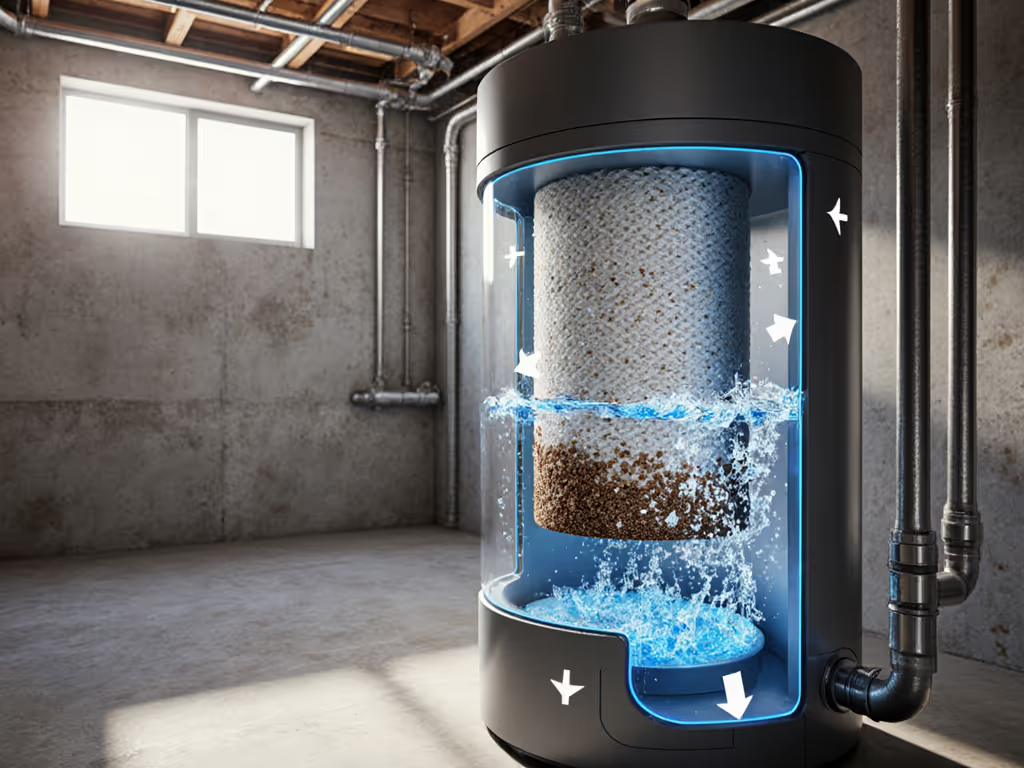
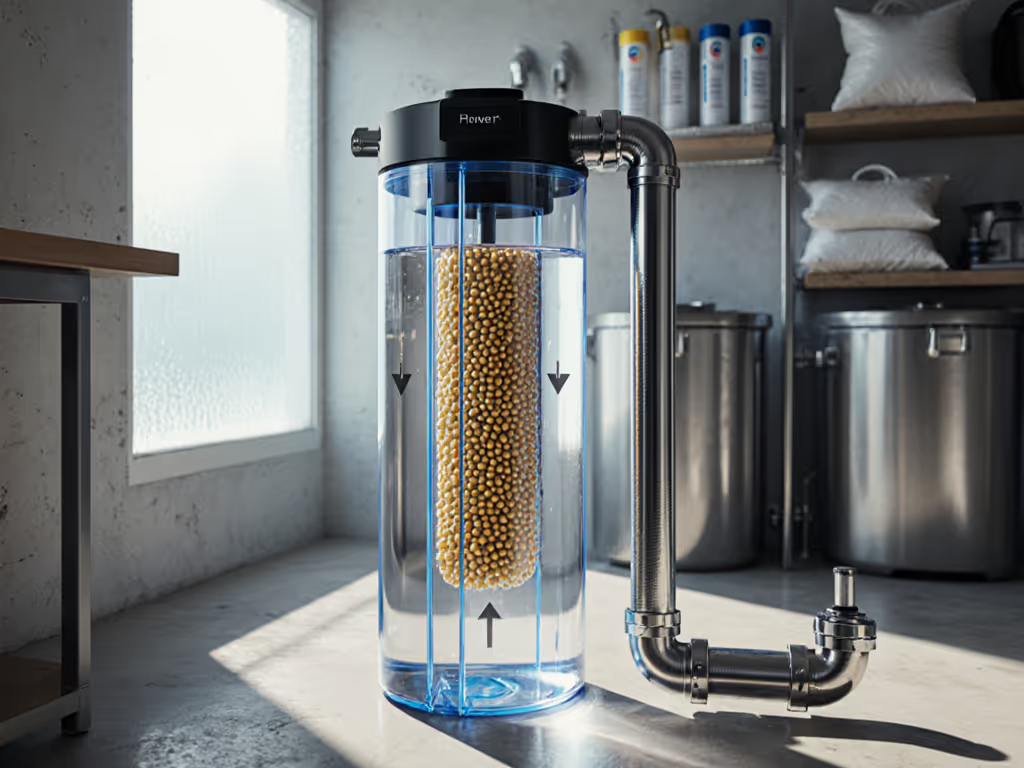
Ion exchange is a physical-chemical process where undesirable ions (like calcium and magnesium) are swapped for more soluble ions (typically sodium). The exchange occurs on resin beads with fixed negative charges that attract positively charged ions (cations). Here's the simple equation:
2R-Na + Ca²⁺ → R₂-Ca + 2Na⁺
(Where R represents the resin bead)
This NSF/ANSI Standard 44-compliant process doesn't remove ions. It exchanges them. Crucially, the total dissolved solids (TDS) remain relatively constant; you're swapping one salt (calcium carbonate) for another (sodium chloride). A water softener reduces scaling potential, not overall mineral content. To understand what else might be in your tap beyond hardness, see our tap water contaminants checklist.
How Does the Ion Exchange Process Work Step by Step?
- Hard Water Entry: Water with 1+ grains per gallon (gpg) of hardness (17.1 mg/L) enters the resin tank
- Ion Attraction: Negatively charged resin beads attract Ca²⁺ and Mg²⁺ ions (which have stronger positive charges than sodium)
- Mineral Swap: Calcium and magnesium displace sodium ions on the resin (2 sodium ions per calcium ion due to charge differences)
- Soft Water Exit: Water now contains sodium instead of hardness minerals, with hardness typically reduced to <1 gpg
When I moved into my downtown high-rise, the utility claimed "excellent water quality," yet my kettle scaled within weeks. Pulling the Consumer Confidence Report confirmed calcium levels at 145 mg/L (8.5 gpg), enough to damage appliances. Not sure how to interpret yours? Use our CCR interpretation guide. The math doesn't lie.
Why Does a Water Softener Need Salt?
The "salt in water softener" question has a precise chemical answer: regeneration requires high-concentration sodium ions to displace accumulated calcium and magnesium. During regeneration:
- A 10-30% brine solution (sodium chloride dissolved in water) floods the resin bed
- The sheer volume of Na⁺ ions (Le Chatelier's principle) forces Ca²⁺ and Mg²⁺ off the resin
- Typical salt usage: 6-15 lbs per regeneration cycle (1 lb per 4,000 grains of capacity)
For a household with 20 gpg hardness using 100 gallons/day, that's ≈7 lbs of salt monthly. The sodium increase in softened water follows this calculation:
Sodium added (mg/L) = (Hardness in mg/L as CaCO₃) × 0.078 × 2.5
A 150 mg/L hardness water adds ≈29 mg/L sodium (1.2 mg per 8oz glass), less than a slice of bread (165 mg). If sodium is medically contraindicated, potassium chloride can substitute, though it's 30-40% more expensive per pound.
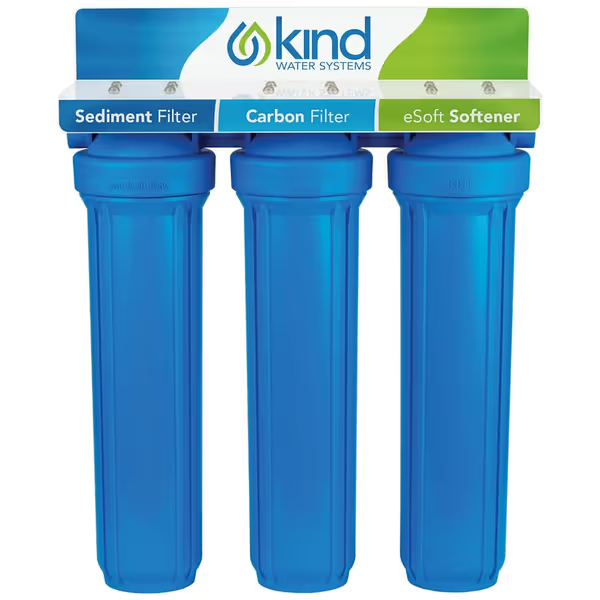
Whole House Salt-Free Softener & Filter Combo
Filters & conditions entire home water supply, salt-free.
$1698.3
Max Bathrooms6
Max Bathrooms6
Pros
Removes chlorine/chloramine & VOCs
Salt-free conditioning prevents scale
Cons
Mixed results on water hardness reduction
Customers find the water purification system easy to install and appreciate its value for money. The water quality receives positive feedback, with one customer noting an immediate improvement after installation. The water hardness aspect receives mixed reviews.
Customers find the water purification system easy to install and appreciate its value for money. The water quality receives positive feedback, with one customer noting an immediate improvement after installation. The water hardness aspect receives mixed reviews.
How Does Regeneration Work?
Regeneration restores resin capacity through four phases:
- Backwash (10-15 mins): Reverses flow to expand resin bed (50% expansion), flushing trapped sediment
- Brine Draw (30-60 mins): Draws concentrated salt solution through resin at 0.5-1.0 gpm
- Slow Rinse (15-30 mins): Flushes residual brine at service flow rate
- Fast Rinse (5-10 mins): Compacts resin bed for optimal future service
A full regeneration cycle typically uses 35-65 gallons of water. Modern softeners with demand-initiated regeneration (DIR) only regenerate when needed, based on actual water usage (not a fixed timer), reducing salt and water waste by 20-35% compared to older models.
How Does Ion Exchange Compare to Alternative Softening Methods?
| Method | Mechanism | NSF Certification | Residual Hardness | Waste Water |
|---|---|---|---|---|
| Ion Exchange | Cation exchange | NSF/ANSI 44 | <1 gpg | 35-65 gal/regen |
| Template-Assisted Crystallization (TAC) | Nucleation sites | NSF P231 | 1-2 gpg | None |
| Electromagnetic | Magnetic field | No NSF standard | 3-5 gpg | None |
TAC systems (sometimes marketed as "salt-free water conditioners") don't remove hardness but alter crystal formation to reduce scaling. Independent testing shows they reduce scale by 40-70% compared to ion exchange's 95-99% reduction, significant for appliance protection in moderately hard water (7-10 gpg). For severe hardness (>15 gpg) or documented scale damage, ion exchange remains the only method with comprehensive NSF validation.
certified reduction, not vibes
How Do I Know If I Need a Water Softener?
Skip the guesswork. Test first.
Hard water is defined as:
- Moderate: 3.5-7.0 gpg (60-120 mg/L)
- Hard: 7.0-10.5 gpg (120-180 mg/L)
- Very Hard: >10.5 gpg (>180 mg/L)
Signs you need appliance protection:
- Soap scum that doesn't rinse clean (hardness > 7 gpg)
- Visible scale inside kettles or showerheads
- Reduced water flow from aerators
- Spotty dishes after dishwasher cycle
Run a certified water test (check your municipal Consumer Confidence Report or get a well test). If hardness exceeds 3 gpg and you're experiencing scaling issues, calculate your break-even point:
Annual softener cost ÷ Annual appliance repair savings = ROI
For most households with >7 gpg hardness, a water softener pays for itself in 3-5 years through extended appliance life. For a simple cost model across systems, check our cost per gallon guide.
How Do I Verify My Water Softener Is Working Properly?
Don't trust the "soft" feel. Test:
- Conduct a hardness test with an NSF-certified test strip (e.g., 3M AquaChek)
- Check for consistent output <1 gpg during service flow
- Monitor pressure drop across the system (>15 psi indicates fouling)
Monthly verification with a calibrated test kit (not just TDS meters) confirms actual performance. If numbers drift, follow our water filter troubleshooting guide for quick fixes. Remember: NSF/ANSI 44 certification requires softeners to maintain <1 gpg hardness for 95% of their rated capacity. Look for this specific claim, not just "NSF certified."
After my high-rise experience, I now verify every system I recommend with a 30-day usage log cross-referenced with hardness tests. The spreadsheet never lies. When certifications match real-world performance, you get results.
Final Considerations
Ion exchange remains the gold standard for hard water softener applications where scale prevention is critical. But don't install blindly: map your water profile first, then choose systems with verified performance data. For moderate hardness where sodium isn't a concern, ion exchange delivers predictable appliance protection with NSF/ANSI 44 certification as your safety net.
When evaluating any water treatment solution, prioritize independent lab reports over marketing claims. Request the specific test data for your water's hardness level, not generic "up to" claims. True protection comes from certified reduction, not vibes.
Related Articles