Water Pressure & Filters: Why Flow Drops & Solutions
By Diego Alvarez • 28th Apr
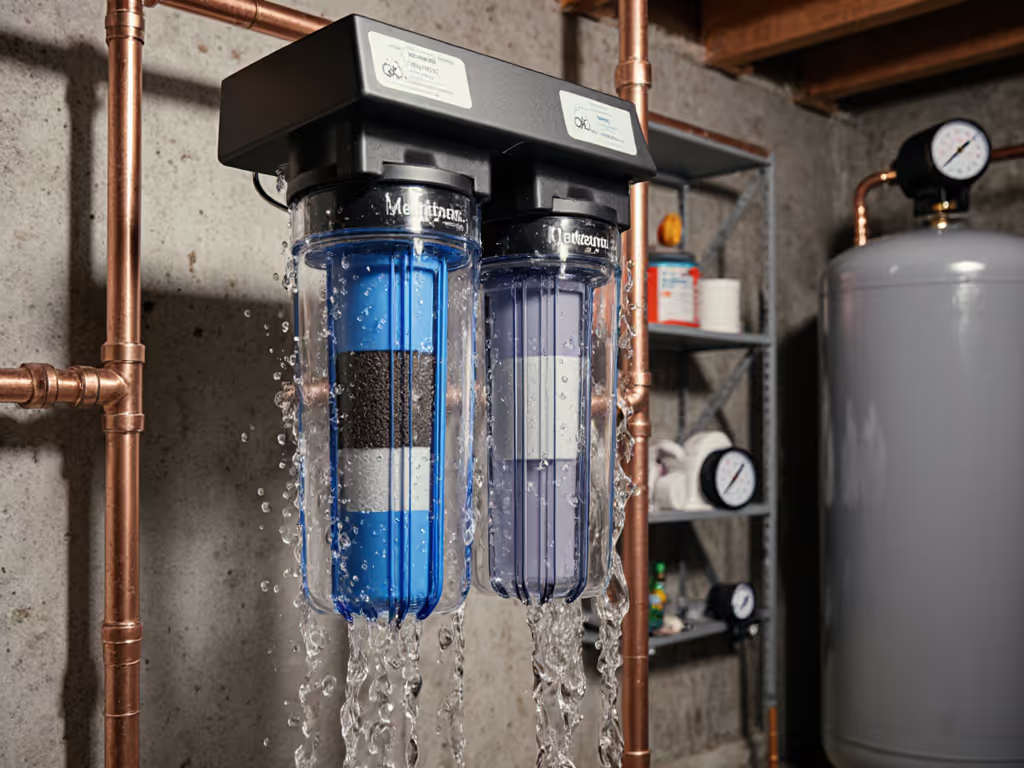
Why Does My Water Pressure Drop When I Install a Filter?
If you've noticed a change in flow after adding a water pressure and filtration system, you're not alone. The honest answer: every filter introduces pressure drop - it's physics. Water must pass through media designed to trap contaminants, and that resistance costs flow. The good news is that this isn't always a dealbreaker, and understanding the math helps you choose a system that protects your household without turning your daily routine into a slow trickle. If low or fluctuating pressure is your reality, see our lab-tested filters for low-pressure homes to avoid severe flow loss.
When water molecules collide with activated carbon, ion-exchange resin, or membrane pores, they lose kinetic energy. This is called pressure loss, and it's measured in pounds per square inch (psi). A whole-house system might drop your pressure by 5-15 psi; a point-of-use filter under the sink may drop it by 2-10 psi, depending on the cartridge type and how much water you're pushing through. The critical part is knowing your baseline pressure, understanding your household's actual flow needs, and matching the filter's design to both.
This isn't just about convenience, it is about durability. Undersized water lines, undersized filter housings, or wrong fittings force higher velocity and turbulence, which shortens cartridge life and stresses connections. If a system is frustrating to use because the flow is too slow, families often skip maintenance or abandon it entirely. And if it is hard to maintain, it will not protect you. That's why hands-on notes start with pressure and flow metrics before certification claims.
Understanding Your Baseline: Pressure, Flow, and Plumbing Requirements
Household water pressure typically runs 40-80 psi at the main line, though municipal systems vary by region and time of day. Most codes and manufacturers recommend maintaining at least 20 psi at the point of use - below that, fixtures won't work reliably.
Flow rate is measured in gallons per minute (GPM) or gallons per day (GPD) at rated pressure. A standard kitchen faucet flows at 2.2 GPM; a shower at 2.5 GPM. Toilets need just 0.5-1.0 GPM. When you add a filter, the effective flow shrinks because some pressure gets consumed by the media. Your plumbing pressure requirements stay the same - you still need enough water to fill a glass, take a shower, and flush without waiting. That's where the arithmetic matters.
How Filters Actually Lower Pressure: The Technical Picture
Here's the sequence:
- Clean cartridge, low turbidity water → minimal pressure drop (1-3 psi for activated carbon, 2-5 psi for RO membranes at rated flow).
- Cartridge loading with sediment and contaminants → pressure drop increases over time. A carbon cartridge might start at 3 psi drop and climb to 8 psi by the time it needs replacement.
- Wrong GPM for the housing → if you force 5 GPM through a filter rated for 2 GPM, pressure drop skyrockets (quadratically) and shortens cartridge life.
For under-sink reverse osmosis systems, the math is even tighter. A high-capacity RO membrane rated around 800 GPD requires consistent inlet pressure of 40-60 psi to maintain that output. Drop to 30 psi, and your flow cuts dramatically. This is why RO systems include prefilters and often work best in homes with stable municipal pressure, not wells with fluctuating supply. Not sure whether a storage tank would help your flow? See our tank vs tankless RO comparison for pressure and output trade-offs.
On-demand tankless RO systems are particularly sensitive because they have no storage buffer. A moment of low pressure means low output now, not a delayed refill later. Faucet-mounted filters, by contrast, sacrifice some GPM but are simpler - you're just filtering the fraction of water you actually use at that outlet.
The Pressure Drop Calculation: Why It Matters for Your Setup
The relationship between pressure and flow isn't linear, it follows a curve. When you know three variables - inlet pressure, filter media type, and cartridge age - you can predict flow.
Pressure Loss Calculation basics:
- Clean activated carbon cartridge at 60 psi inlet, manufacturer rated for 2.5 GPM → expect roughly 2.5 GPM at the outlet after a 3 psi drop.
- Same cartridge after 6 months of use, same inlet pressure → contaminant loading may increase drop to 6 psi, reducing outlet flow to ~2.1 GPM.
- Prefilter clogged with sediment → pressure drop can spike to 15 psi, cutting flow to a trickle and signaling replacement urgency. A correctly sized sediment pre-filter can stabilize downstream pressure and extend carbon cartridge life.
For under-sink systems, test this yourself: note flow before filter installation using a calibrated container and stopwatch. Then install your filter and repeat the measurement at the same faucet. If you see a drop larger than 30-40% (e.g., 2.2 GPM down to 1.3 GPM), the system is operating within normal range but at the lower end of comfort. Some households accept this trade-off for the filtration benefit; others don't.
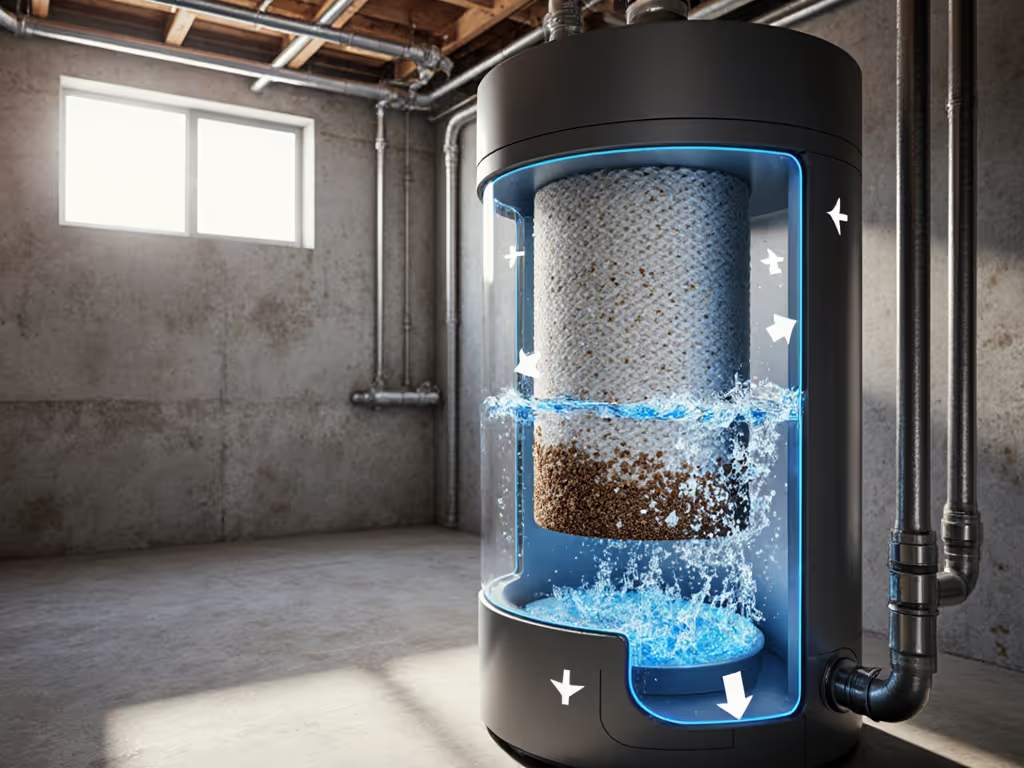
Whole-house filters demand a different checksheet. Review flow-rate and pressure-drop data in our whole house filter comparison to size a system that won't starve your fixtures. Here, a 5-10 psi drop across a combined sediment and carbon stage is acceptable because it affects all fixtures, and homes are designed for some variance. If you're dropping 15+ psi, however, you risk weak shower pressure and slow hot-water delivery - classic signs of incompatibility.
Plumbing System Compatibility: The Install-Time Reality Check
Before you buy any filter, audit your actual setup:
Safety cautions noted:
- Shut off the water supply at the main shutoff valve before measuring pressure or inspecting plumbing.
- Use a water-pressure gauge (inexpensive, available at hardware stores) to measure your baseline inlet pressure at an outdoor faucet or sink outlet.
- Check your municipal water report or well test to confirm your typical minimum and peak pressure.
- If pressure is below 40 psi, discuss booster-pump options with a plumber before purchasing a filter that assumes 60 psi input.
Preflight checklist:
- Inlet line size: Undersized supply lines (e.g., 1/2-inch copper in an older home feeding multiple floors) are often the culprit in perceived low pressure and uneven flow, especially during peak demand.
Related Articles