Water Filtration for Renal Diets: Sodium Potassium Control Guide
By Samira Khan • 9th Dec
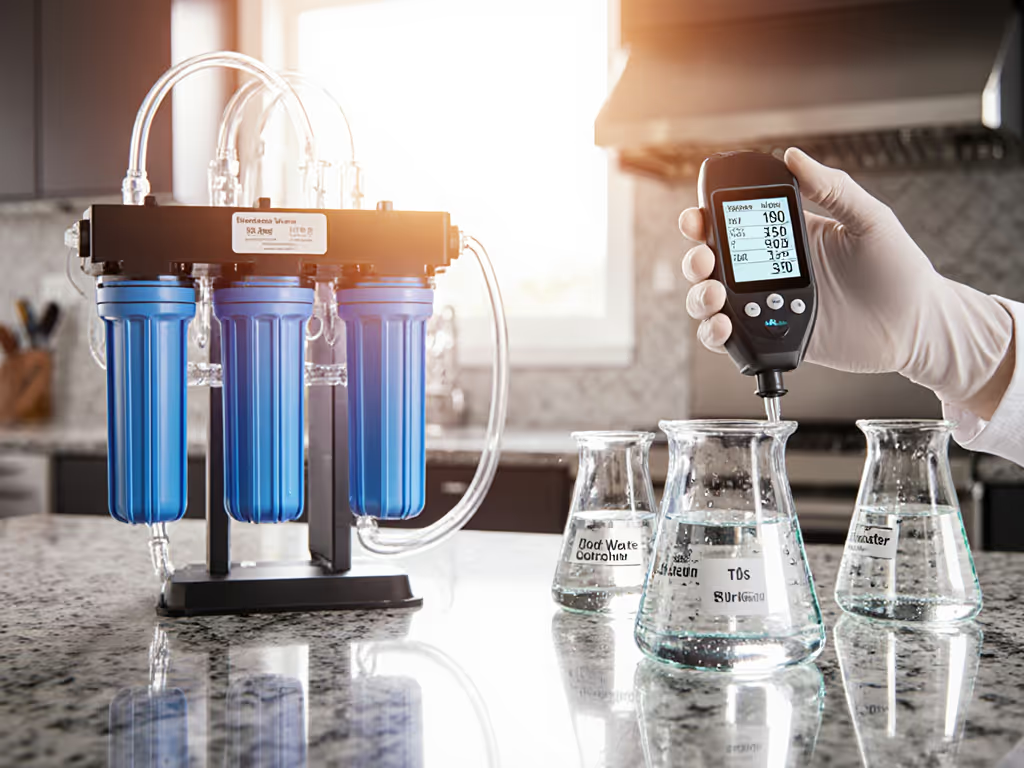
When balancing a renal diet, water filtration becomes a critical but often misunderstood component. Many patients and caregivers fixate on expensive specialty filters marketed for "kidney health," only to discover too late that standard municipal water rarely contributes meaningfully to sodium or potassium intake. For those managing chronic kidney disease (CKD), understanding what your tap water actually contains (and which renal diet water filter solutions make fiscal and physiological sense) is the difference between wasted spending and sustainable health management. Let's cut through the noise with simple math and verified data.
The Hidden Cost of Renal Diet Missteps
Why Water Matters More Than You Think (But Less Than Marketing Claims)
Renal nutrition guidelines consistently emphasize strict sodium (<2,000 mg/day) and potassium (<2,000 mg/day) limits for CKD stages 3 to 5. Yet here's what's rarely stated: municipal tap water contributes less than 5% of daily sodium/potassium intake for most patients. Per EPA data, average U.S. tap water contains only 10 to 50 mg/L sodium and <5 mg/L potassium. Even drinking 2 liters daily adds just 20 to 100 mg sodium, which is trivial next to a single serving of processed food (e.g., 1 cup canned soup = 800 mg sodium).
This creates a dangerous paradox: Patients panic about water contaminants while overlooking higher-impact dietary sources. I've seen families spend $500+ on "potassium-removal filters" for water containing less potassium than half a tomato. Worse, some aggressive filtration (like reverse osmosis) strips beneficial minerals without addressing actual dietary threats. Your anxiety is valid, but misdirected.
The Real Pain Points Nobody Talks About
When renal patients ask about filters, three hidden issues dominate:
- Confusion about filter capabilities: Most carbon filters (pitchers, fridge inserts) do not remove dissolved sodium/potassium. Only RO systems reduce these minerals, but often to unnecessarily low levels.
- Misplaced urgency: Dialysis patients face stricter fluid restrictions (often 32 to 64 oz/day) than sodium concerns from water. Yet marketing preys on fears of "toxic water."
- Cost traps: Proprietary filters for "renal-specific" systems cost $3 to $8/gallon versus $0.10 to $0.50 for standard certified replacements.
Remember: A 2024 Kidney International study confirmed that dialysis water safety depends on RO purification to remove chloramines and microbes, but this applies only to hemodialysis machines, not home drinking water. Your tap water isn't dialysis fluid.
Your Action Plan: Filter Smarter, Not Harder
Step 1: Verify Your Actual Water Composition (It's Free)
Skip the guesswork. Request your municipal Consumer Confidence Report (CCR) (required by law and available online for about 90% of U.S. utilities). Look for these lines: If you need help reading it, use our CCR interpretation guide.
| Contaminant | Typical Municipal Level | CKD Dietary Risk Threshold |
|---|---|---|
| Sodium | 10 to 50 mg/L | >100 mg/L (rare) |
| Potassium | <5 mg/L | >20 mg/L (extremely rare) |
| Chloramines | 2 to 4 mg/L | Cosmetic concern only |
If your CCR shows sodium <100 mg/L and potassium <20 mg/L (99% of systems do): You need only basic carbon filtration for taste/odor. No mineral removal required. A simple NSF/ANSI 42-certified filter (removing chlorine) costs pennies per gallon.
Step 2: Filter Selection Based on Your Stage
For CKD Stages 1 to 2 (No Restrictions)
- Reality: Water intake of 64 oz/day is encouraged per Kidney Research UK.
- Filter Need: None, unless addressing taste/odor. If so, use a $20 pitcher filter with NSF 42 certification.
- Cost Math: $0.02/gallon vs. $1.50/gallon for bottled water. Payback period: <3 weeks.
For CKD Stages 3 to 5 (Sodium/Potassium Restrictions)
- Reality: Water itself isn't the sodium/potassium vector. Focus on dietary sources.
- Filter Need: Only if CCR shows elevated minerals (uncommon). Use RO only if sodium >150 mg/L (rare outside well water). If RO is truly needed, review our NSF 58 reverse osmosis standards guide to verify medical-relevant performance.
- Cost Math: RO systems cost $0.25 to $0.50/gallon with maintenance. For 64 oz/day, that's $50 to $100/month vs. $0.50/month for carbon filters. Ask: Does my water actually exceed limits?
For Hemodialysis Patients
- Critical Note: Home hemodialysis machines require RO-purified water. Use only medical-grade systems. Do not adapt drinking water filters for this.
- Drinking Water: Still no need for special filters unless CCR shows contaminants. Standard carbon filtration suffices.
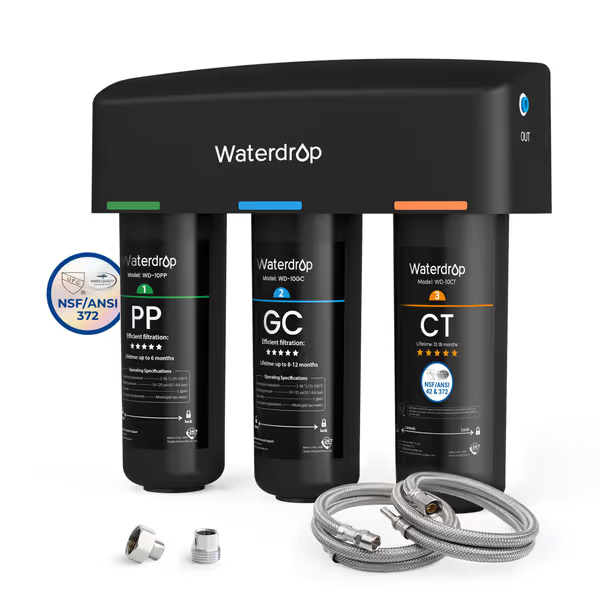
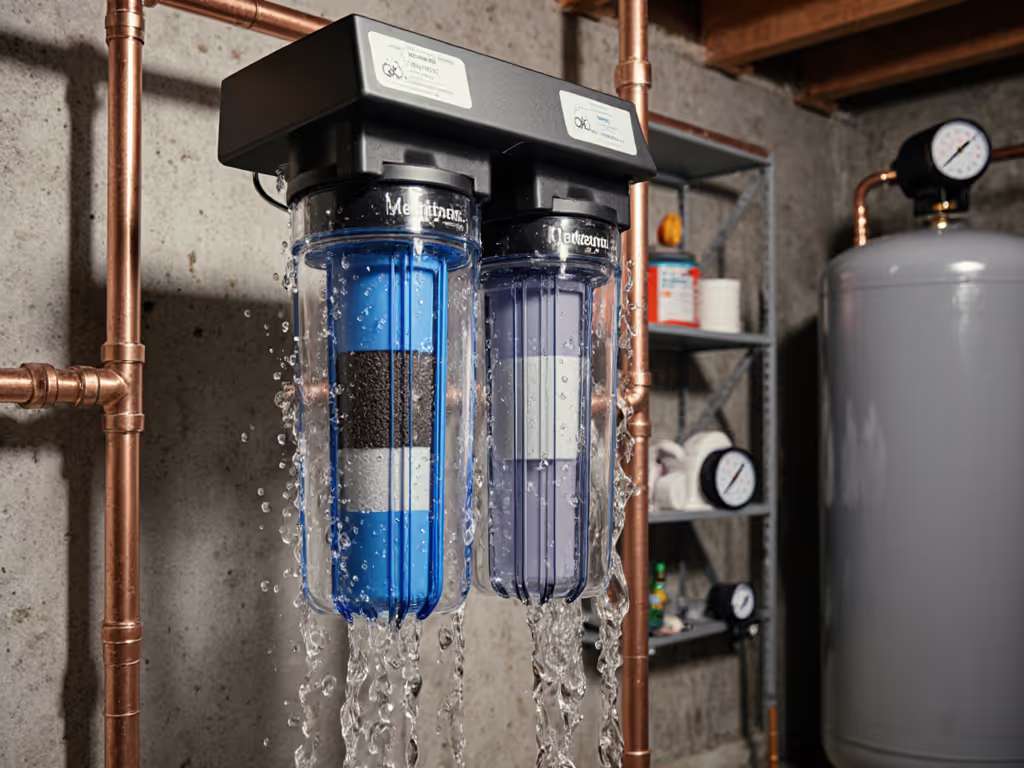
Waterdrop TSA 8-Layer Under Sink Filter
8-stage filtration for municipal water: reduces PFAS, chlorine, heavy metals.
$99.99
Filter LifespanUp to 18 months
Filter LifespanUp to 18 months
Pros
Certified reduction of PFAS, chlorine, and heavy metals.
Easy DIY installation, 3-second filter replacement.
Cons
Not suitable for well water or hot water.
Customers find the water filter effective at improving water quality, with one mentioning it removes sediment from ice. The installation process is straightforward, and customers appreciate that it saves money by reducing the need for bottled water. While some customers report good water pressure and flow, others experience decreased pressure and low flow. The filter is effective at removing chlorine but does not remove fluoride, and customers note it has no smell.
Customers find the water filter effective at improving water quality, with one mentioning it removes sediment from ice. The installation process is straightforward, and customers appreciate that it saves money by reducing the need for bottled water. While some customers report good water pressure and flow, others experience decreased pressure and low flow. The filter is effective at removing chlorine but does not remove fluoride, and customers note it has no smell.
Step 3: Maintenance That Won't Break Your Budget
Here's where most renal patients get burned. Proprietary "renal" filter subscriptions charge $50 to $150 for 3-month cartridges containing basic carbon. To avoid overpaying, compare filter subscription services on cost, convenience, and flexibility. Meanwhile, modular systems with industry-standard parts last longer and cost less. Example maintenance calendar:
| Filter Type | Replacement Interval | Cost/Gallon | Annual Cost |
|---|---|---|---|
| Pitcher (generic) | 2 months | $0.05 | $12 |
| Countertop RO (AquaTru-type) | RO membrane: 24 mos | $0.35 | $154 |
| Waterdrop-style under-sink | Carbon: 12 mos | $0.12 | $37 |
Assumptions: 64 oz/day usage; AquaTru cartridge costs $129/set; Waterdrop carbon block $29.99. Open-spec parts avoid subscription lock-in.
Notice what's missing? "Potassium removal cartridges" aren't listed because no certified home filter targets potassium specifically (it's impractical at tap-water concentrations). Focus on what matters: NSF 58 certification for RO systems (if truly needed), NSF 42 for carbon filters, and third-party test reports matching your contaminants.
The Sustainable Path Forward
When my first child arrived, we panicked about tap water safety for formula. Simple calculations revealed our municipal water met all standards, and yet we nearly bought a $600 "medical-grade" filter. The best filter is the one you can afford to maintain, sustainably. For renal diets, that usually means:
- Ignoring marketing hype around "potassium-removal filters"
- Prioritizing carbon filtration for taste/odor (NSF 42)
- Using RO only if water reports confirm high sodium (rare)
- Choosing modular systems with widely available cartridges
Final Checklist Before You Buy
- REQUEST YOUR CCR: don't assume contaminants exist.
- CONFIRM sodium <100 mg/L and potassium <20 mg/L (if higher, consult nephrologist before filtering).
- CHOOSE NSF 42-certified carbon filters if addressing chlorine/taste.
- CALCULATE true cost/gallon: (Filter cost ÷ rated capacity) + shipping.
- AVOID anything marketed as "renal-specific" (it's almost always a markup).
Spend on media that works, not on pretty housings. For most renal patients, that's a $30 carbon filter replaced annually, not a $500 system with proprietary cartridges. Your budget, kidneys, and peace of mind will thank you.
Related Articles