International Water Filter Certifications Explained
By Arjun Mehta • 16th Jan
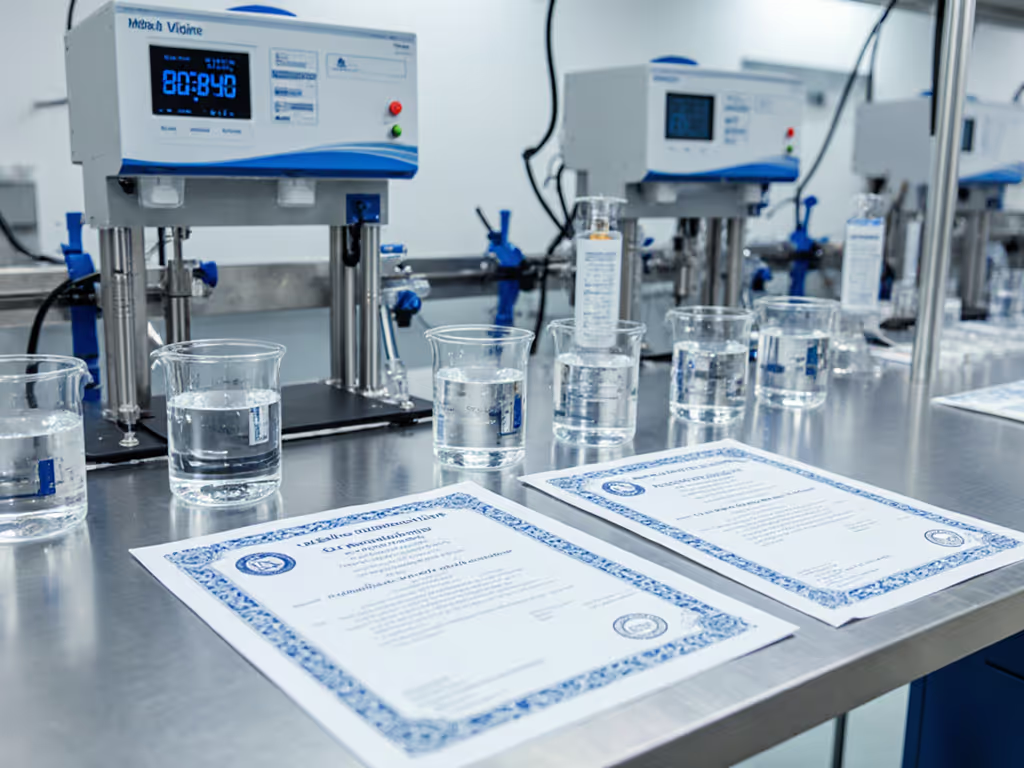
After moving into a high-rise where the utility's Consumer Confidence Report painted a rosy picture but my kettle told a different story, I learned that understanding international water filter certifications and global water standards becomes your best defense against marketing claims that don't match reality. These certifications aren't just stickers (they're verification that a filter actually removes what matters in your water), validated through standardized testing protocols that transcend borders. Map your water, then let certifications drive the filter choice.
FAQ Deep Dive: Global Certification Clarity
What makes a certification "international" versus country-specific?
Not all certifications hold equal weight globally. The true "international" water filter certifications are those based on universally recognized protocols that other countries accept through mutual recognition agreements. While NSF/ANSI standards originated in the U.S., they've become the de facto global benchmark, with over 170 countries now referencing them in their regulatory frameworks (per NSF International's 2025 report). If you're deciding between basic taste/odor and health-focused claims, see our NSF 42 vs 53 guide for what each standard actually verifies.
Country-specific certifications like Japan's JIS certification (focusing on basic contaminant reduction and structural integrity), Germany's KTW certification (primarily material safety for plumbing components), or France's ACS certification (emphasizing microbiological safety and chemical resistance) serve important local purposes but lack the comprehensive contaminant reduction verification of NSF/ANSI 53 or P473. The critical distinction: international certifications validate performance against specific contaminants under standardized flow and capacity conditions, not just material safety.
How do I determine if "water filter certification equivalence" is legitimate?
True certification equivalence requires matching both testing methodology and performance thresholds. For example, while Germany's DVGW W270 standard tests for lead reduction similarly to NSF/ANSI 53, it uses different challenge concentrations (200 μg/L vs 150 μg/L) and requires 85% reduction versus NSF/ANSI 53's 99%+ for lead. To compare WRAS, DVGW, and KIWA certifications against NSF, use our European certifications explainer. This creates a 14% performance gap that matters for households with lead service lines.
Evaluate equivalence by checking:
- Contaminant challenge levels (must match or exceed local regulatory limits)
- Reduction percentage requirements (NSF/ANSI 53 requires ≥99% for lead; some international standards accept 85-90%)
- Flow rate testing conditions (must reflect real-world usage)
- Duration requirements (must test through full cartridge life, not initial performance only)
When comparing systems, calculate the actual performance margin: (Certified reduction % - Minimum required %) × Challenge concentration. A filter certified to remove 99.5% of 150 μg/L lead delivers 0.75 μg/L residual (0.00075 mg/L), while one at 85% delivers 22.5 μg/L (15 times higher).
Which certifications validate PFAS reduction claims globally?
This is where global water standards reveal significant gaps. NSF P473 remains the only standardized test protocol specifically for PFAS reduction (covering PFOA, PFOS, and related compounds at 100-500 ppt challenge levels). For related standards like NSF 58 and NSF 401, see how RO and emerging contaminant protocols are validated. While Japan's JIS certification has added PFAS testing since 2023, it uses less stringent 1,000 ppt challenge levels and only verifies initial performance, not sustained reduction through cartridge life.
Europe's KIWA standard (NEN-EN 15299) verifies PFAS reduction but focuses on industrial applications, not household filters. France's ACS certification doesn't yet include PFAS testing protocols. Always verify:
- The specific PFAS compounds tested (PFOA/PFOS vs. broader 29+ compound panels)
- Challenge concentrations (must be ≤ EPA's 4 ppt advisory level)
- Performance duration (must cover full rated capacity)
For example, a filter certified to NSF P473 at 100 ppt challenge achieving 95% reduction delivers 5 ppt residual (still above EPA's health advisory but significantly better than uncertified claims of "PFAS removal").
How much performance variation exists between "certified" products?
Certification sets minimum standards, but actual performance varies significantly within certified products. NSF/ANSI 53 requires ≥99% lead reduction, but certified filters range from 99.0% to 99.97% in independent verification studies. While this seems minor, at 150 μg/L lead input, it means:
- 99.0% reduction = 1.5 μg/L residual
- 99.97% reduction = 0.045 μg/L residual
That's a 33x difference in residual lead, critical for infant formula preparation where EPA recommends ≤1 μg/L. Similarly, cyst reduction ranges from NSF/ANSI 53's minimum 99.95% (1 in 2,000 organisms passing) to gold-standard 99.9999% (1 in 1,000,000) in some P231-certified systems.
show your math: Calculate residual concentration = Input concentration × (1 - Reduction decimal). For 150 μg/L lead at 99.0% reduction: 150 × (1 - 0.990) = 1.5 μg/L. At 99.97%: 150 × (1 - 0.9997) = 0.045 μg/L.
Do certifications verify ongoing performance or just initial testing?
Reputable certifications require performance verification throughout the rated lifespan, not just at installation. NSF/ANSI standards mandate testing at 50%, 75%, and 100% of rated capacity (e.g., for a 400-gallon filter, tests at 200G, 300G, and 400G). Certification to NSF/ANSI standards is valid for one year, requiring annual recertification with random market sampling.
This contrasts sharply with certifications like basic JIS or KTW, which often only validate initial performance. For filters claiming 6-month life, this means:
- NSF-certified: Verified reduction at 1 month, 3 months, and 6 months
- Basic certifications: Verified only at installation
The difference becomes critical for contaminants like chlorine where carbon filters exhaust progressively, NSF/ANSI 42 certified pitchers maintain ≥50% chlorine reduction to full capacity, while uncertified models may drop below 20% after 50 gallons. For real-world timelines, review our lab-tested performance decay data showing when breakthrough begins across filter types.
How do I translate certification claims into real-world protection?
Convert lab results to household realities using your water profile. If your municipal report shows 2.0 mg/L chlorine (typical post-disinfection level), an NSF/ANSI 42 certified filter claiming 75% reduction delivers 0.5 mg/L residual, still above the 0.2 mg/L threshold where taste/odor becomes noticeable for sensitive palates.
Calculate your actual protection:
Residual concentration = (Source concentration) × (1 - Certified reduction decimal)
Cost per gallon = (Cartridge cost) ÷ (Rated capacity in gallons)
True protection cost = Cost per gallon ÷ (1 - Reduction decimal)
For example:
- Filter A: $60 for 400 gallons, 75% chlorine reduction → $0.15/gal, $0.60 true cost per protected gallon
- Filter B: $120 for 1,000 gallons, 95% reduction → $0.12/gal, $2.40 true cost per protected gallon
While Filter B costs less per untreated gallon, Filter A delivers more cost-effective protection for your specific need. Always match certifications to your contaminants of concern, not marketing claims.
The Verification Imperative
Global water standards exist to cut through marketing noise, but their value depends on your ability to interpret them for your specific water profile. That chlorine spike I detected didn't match the utility's assurances, but cross-referencing the Consumer Confidence Report with third-party lab data let me select a filter with verified NSF/ANSI 42 certification that actually addressed my problem.
Don't accept "certified" at face value, verify which standard applies (NSF/ANSI 53 vs 42), which contaminants are covered, and whether testing reflects your actual usage conditions. The most expensive filter isn't always the best solution; the most appropriately certified one for your water is.
show your math, map your water, and let verifiable performance (not promises) guide your choice. For deeper verification, consult NSF's Certified Products Database, WQA's Gold Seal directory, or IAPMO's R&T listings with your specific contaminant thresholds in hand. Your household's health depends on the difference between claimed performance and certified reality.
Related Articles