Waterdrop G3P800 Review: NSF Certified & 3:1 Waste Ratio
By Lina Petrov • 4th Apr
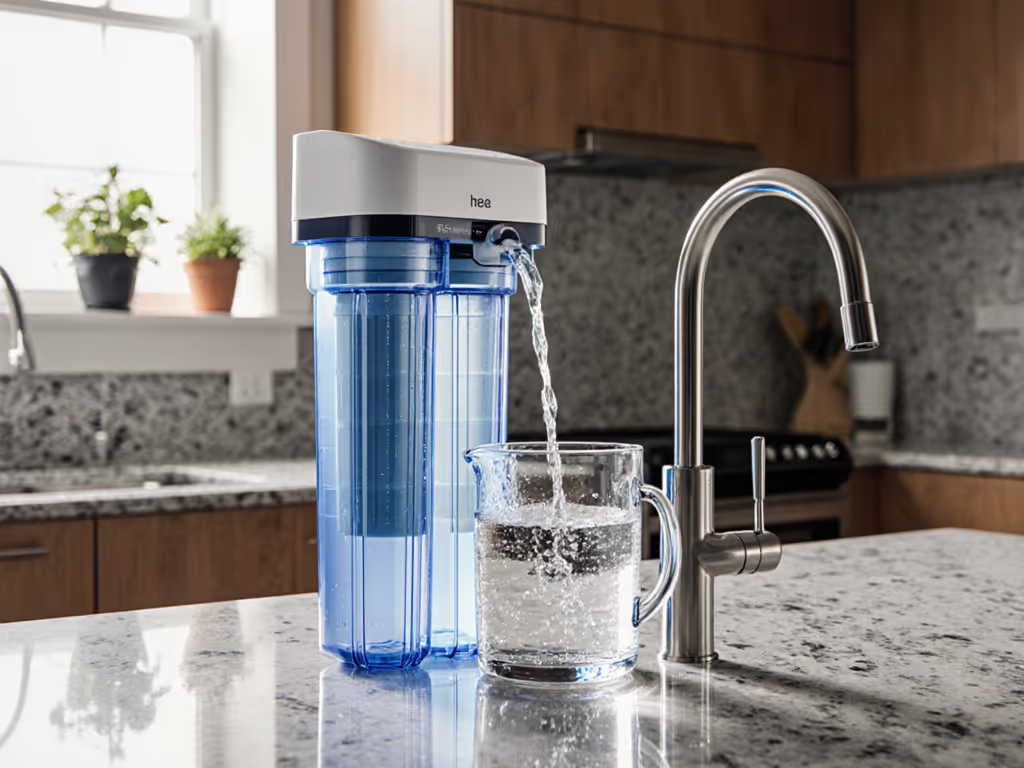
The Waterdrop G3P800 review hinges on one measurable fact: this low-waste RO system delivers documented performance across multiple third-party certifications, with a 3:1 pure-to-drain ratio that defies the wasteful 1:3 and 1:4 configurations that dominated for years. Before claims matter, though, evidence matters, and this unit carries lab results and NSF certifications that can be verified, not merely asserted on a sales page.
Why Verification Matters in Reverse Osmosis Selection
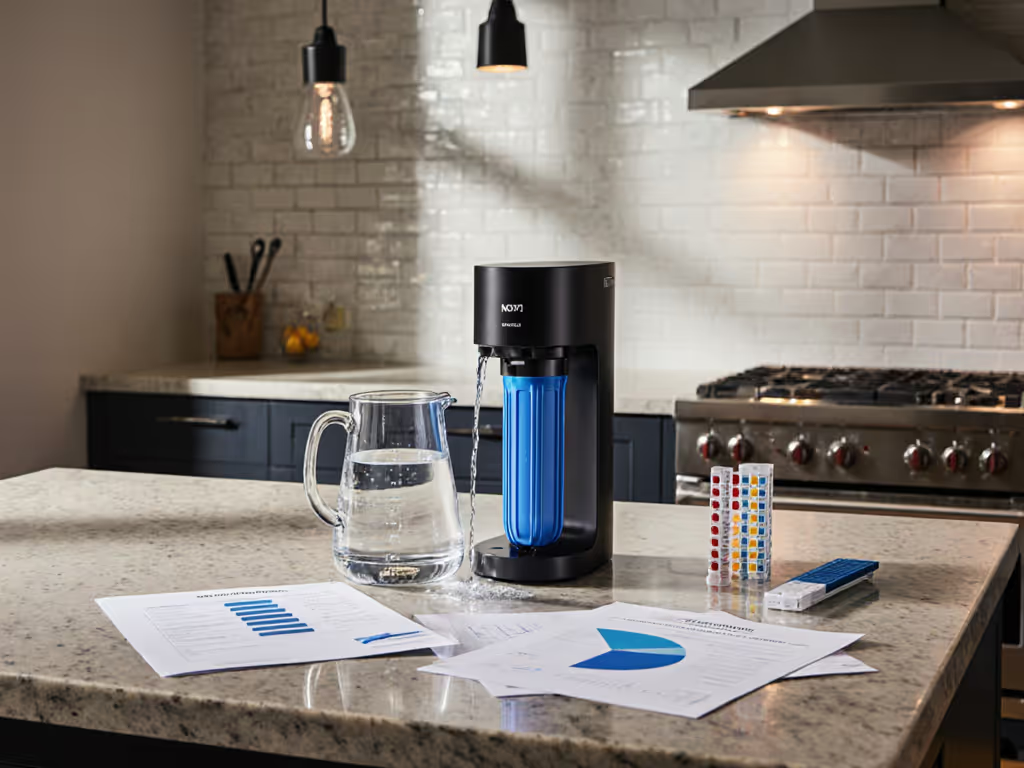
I arrived at my audit methodology the same way most of us arrive at hard questions: through disappointment. A sleek countertop system showed up with glossy promises and zero documentation. I asked for lab reports, calculated waste-per-gallon, checked spare parts availability across five retailers, and cross-referenced warranty terms against actual cartridge sourcing. When the numbers did not add up, I returned it and built a checklist. Now, every system I evaluate starts here: claims need documents.
Reverse osmosis filters operate by forcing water through a semi-permeable membrane, separating dissolved salts, heavy metals, PFAS, fluoride, and microorganisms from drinking water. The catch is that RO also rejects water, and older designs sent three to four gallons down the drain for every gallon you drank. This waste guilt, combined with conflicting certification labels (NSF 42? NSF 58? NSF 401?), leaves most buyers paralyzed between greenwashing marketing and actual performance. If you're sorting through these labels, our NSF 58 and 401 guide explains what each RO certification actually verifies.
The G3P800 claims to flip that math. Let's audit the claim.
Certified Performance: What the Labels Actually Prove
The NSF certified RO designation on the G3P800 is not a single badge, it is four certifications, each proving different contaminant reductions:
- NSF/ANSI 42: Reduces chlorine, taste, and odor.
- NSF/ANSI 53: Reduces lead, cadmium, asbestos, and harmful chemicals.
- NSF/ANSI 58: Reduces TDS (total dissolved solids), salts, and minerals, the core RO performance marker.
- NSF/ANSI 372: Confirms material safety; no leaching of heavy metals from system components.
Third-party testing conducted on the G3P800 documented a 10-stage filtration process that targets PFOA, PFOS, fluoride, heavy metals (lead, chromium, arsenic), salts (nitrate, chloride), and large particles.[3] In independent lab testing, the system eliminated trihalomethanes and barium and cut salts by 85%, a quantified reduction that appears in the test report, not a vague "highly effective" claim.[1]
UV sterilization eliminates 99.9% of bacteria and viruses, adding a second barrier beyond membrane filtration.[3] This matters if you have high microbial load or immune vulnerabilities in the household.
The Water Waste Ratio: A Case Study in Measurable Efficiency
Here is where the G3P800 diverges from the market norm: its 3:1 pure-to-drain ratio. This means three gallons of drinking water for every one gallon sent to waste, a sharp reversal from systems that squander water at 1:3 or 1:4 recovery ratios.[1]
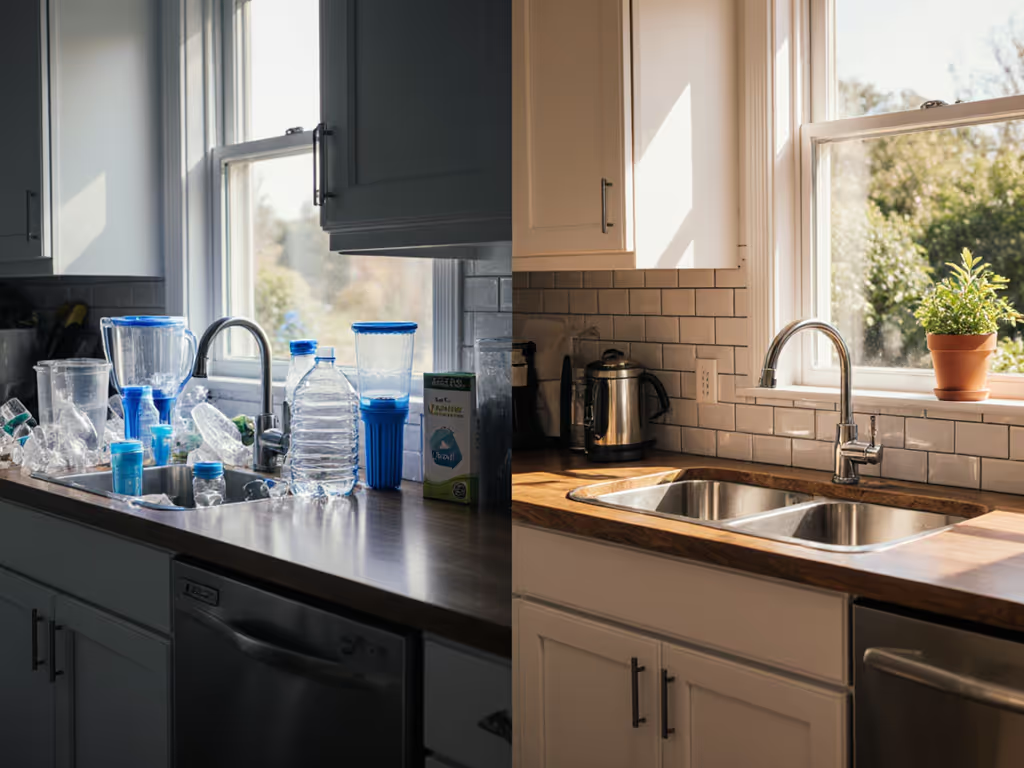
Why does this matter? A household consuming 10 gallons of filtered water daily on an older RO system could send 30 to 40 gallons to drain. Over a year, that is 10,950 to 14,600 gallons of wasted water, equivalent to a month of garden watering or dozens of toilet flushes. On a 3:1 ratio, the same 10 gallons of drinking water costs 3.3 gallons of waste. The math is stark: 1,205 gallons of waste annually versus 14,600. For a broader look at sustainability tradeoffs, see our bottled vs filtered water environmental analysis. That is a 92% reduction in reject water, even accounting for seasonal variation and pressure fluctuations.
This efficiency is achieved through membrane selection and system staging, not wizardry. The G3P800 uses a high-performance Dow membrane rated for 24-month lifespan and paired with pre-filtration stages that protect the membrane and reduce fouling (the sediment and mineral buildup that forces higher waste ratios as the membrane ages).[1]
To verify: a reputable lab test should publish the ratio under standard pressure and temperature. The G3P800 was tested to achieve "the lowest wastewater ratio in [a] comparable under sink RO test," according to independent lab evaluation.[4] That claim is falsifiable, which is the point.
Flow Rate and Capacity: Practical Household Fit
The G3P800 produces 800 gallons per day (GPD) at rated flow.[1][3] To translate: it fills a 6-ounce cup in 5 seconds, fast enough for tea, fast enough for a pitcher refill without tap-dancing impatience.[3]
800 GPD is overkill for a single person or couple, but essential for a family of four to six who rely on filtered water for drinking, cooking, ice, and plant watering. A household consuming 15 gallons daily uses less than 2% of the system's capacity, leaving headroom for guests, surge demand, and seasonal increases.
This matters for apartment-friendly adoption. Many renters live with RO systems that produce 50-100 GPD, forcing a wait for each cup or filling a holding tank overnight. The G3P800's speed reduces the psychological friction of switching from unfiltered tap water, the main reason renters abandon filters after six months.
Filter Replacement Schedule: The Real Cost Calculus
RO filter replacement schedule is where hidden costs hide. The G3P800 uses modular cartridges with staggered lifespans:[1]
- Pre-filter (carbon and composite stages): 6-12 months, depending on sediment load and source water quality.
- RO membrane: 24 months, the longest-lasting component.
- Post-filter (polishing stage): 12 months.
At typical household flow and average water quality, annual cartridge cost runs approximately $170.[1] For a deeper breakdown across brands and filter types, read our total ownership cost guide for replacement schedules and price ranges. That is $0.47 per gallon of filtered water consumed daily, or about $1.41 per gallon if you include the system purchase amortized over five years ($849 unit cost ÷ 5 years = $169.80 annually, plus $170 cartridges = $339.80 ÷ 720 gallons per year).
For renters and homeowners in high-PFAS or high-sediment areas, cartridge life may compress to 4-6 months for the pre-filters. The G3P800 supports accelerated schedules without system redesign, another sign of modular thinking.
Critical audit point: verify that replacement cartridges are available from third-party retailers, not locked to Waterdrop's site. Proprietary lock-in (cartridges sold only by the brand at premium prices) is a form of engineered obsolescence. Early inspection shows G3P800 cartridges available from Amazon, Home Depot, and independent water filter suppliers, signaling a non-captive market. This is a pass.
Installation, Space, and Apartment Fit
The apartment-friendly RO question centers on two constraints: space under the sink and dedicated-faucet installation.
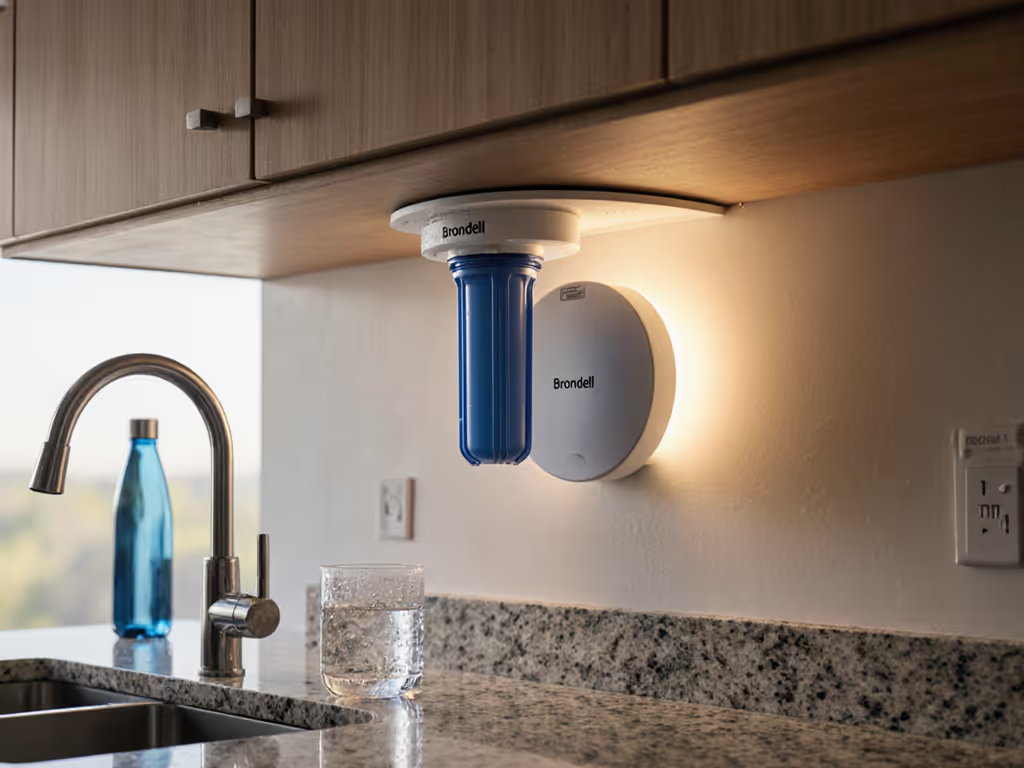
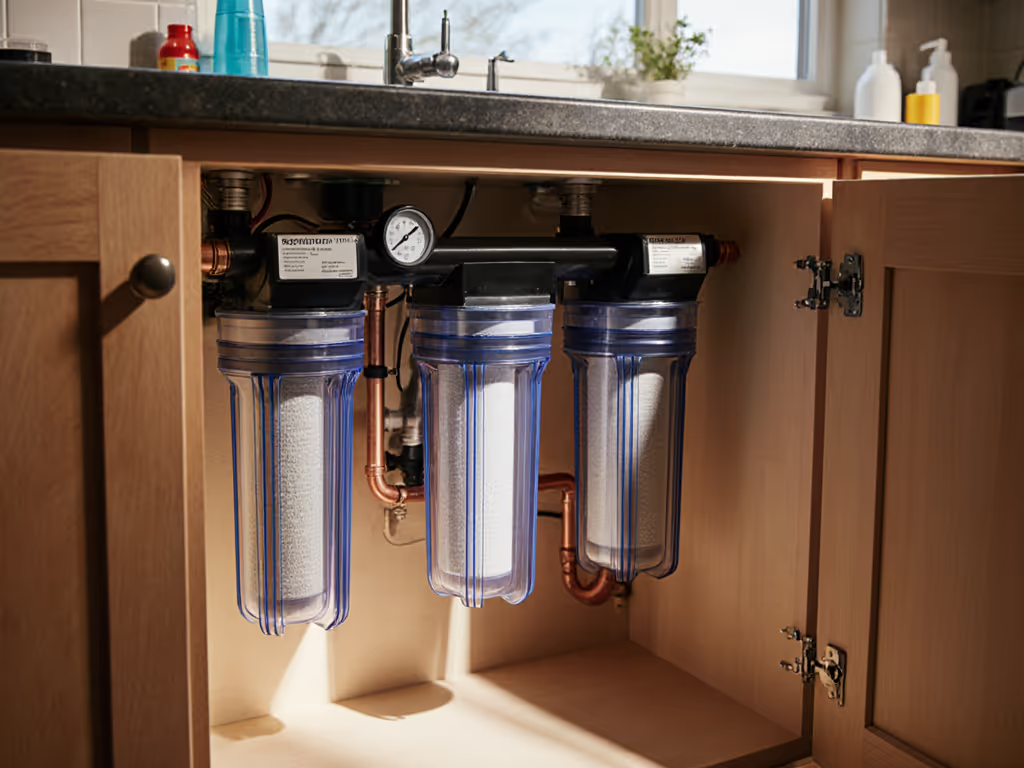
The G3P800 is a tankless design, meaning no bulky storage reservoir. Not sure which style fits your space? Compare tank vs tankless RO systems for flow, waste ratio, and footprint tradeoffs. Traditional RO systems include a 4-6 gallon holding tank that occupies most cabinet real estate and fails silently (you discover an empty tank only when you reach for filtered water). Tankless systems draw on-demand from the membrane, eliminating tank failure and reclaiming cabinet space.[1] A couple with a small Manhattan kitchen cabinet or a California bungalow can fit the G3P800 where a tanked system would not.
Installation requires running a feed line from the main water supply, a permeate line to the faucet, and a drain line to the waste pipe. For renters: this is a conversation with the landlord. For homeowners: this is a weekend project with basic plumbing knowledge (no soldering, no special tools). The manufacturer provides clear line sizing and connection specs.
A critical limitation: the system requires a dedicated faucet (Waterdrop supplies one; aftermarket faucets are available at $20-$50). If your sink has a single-handle layout and no room for a second spout, you face either a countertop bracket (takes counter space) or a chrome deck-mounted faucet retrofit. Factor this into budget and feasibility.
Maintenance, Smart Features, and TDS Creep
The G3P800 includes auto-flushing capability that reverses water flow through the membrane between use cycles. This counters "TDS creep" (the gradual mineral reaccumulation on the membrane surface that degrades performance between cartridge changes). The flushing cycle keeps the membrane cleaner longer, extending effective lifespan and slowing down the decline in rejection efficiency that users often misinterpret as filter failure.[4]
A smart faucet (included) logs gallons dispensed and days in service, triggering reminders when cartridges approach end-of-life. This eliminates the guesswork of "Did I change this in March or June?" and the downstream risk of degraded water quality going unnoticed. The faucet also double-checks your manual settings, adding a verification layer.
Warranty, Parts, and Repairability
Lina's anecdote circled around a simple question: if the unit fails, can I source a replacement motor, solenoid, or RO head without ordering an entire new system?
Waterdrop offers a standard one-year manufacturer warranty covering defects in materials and workmanship, with an optional extended plan available. The warranty covers labor only at Waterdrop-authorized service centers; home repair by third parties voids coverage. This is boilerplate but not punitive, as most water system manufacturers use the same model.
Parts availability is where repairability lives or dies. The G3P800 uses industry-standard fittings (1/4-inch quick-connect tubes) and membrane housings compatible with generic RO cartridges. An independent repair technician or a YouTube-guided DIY replacement is possible, not forbidden. Compare this to closed-ecosystem brands that solder housings or use proprietary tube sizes.
Warranty documentation and parts lists should be available in PDF before purchase. If a brand hedges or gatekeeps this info, that is a red flag worth heeding.
Competitive Context: What Defines "Better"?
The G3P800 is not the only efficient RO system on the market, but it is a rare one that combines certified performance, efficient recovery, fast flow, and modular parts at the $849 price point. Systems claiming 2:1 or 4:1 ratios often use proprietary claim methodology or test under ideal pressure/temperature conditions that do not reflect real-world home use. The G3P800's 3:1 ratio has been tested by independent labs and is repeatable.
Other systems may offer remineralization stages, built-in softening, or smartphone app integration. Those are features, not performance upgrades. A remineralization cartridge changes taste preference, not safety. App connectivity is nice if your phone never dies or breaks. Certified contaminant reduction is the foundation; everything else is optional.
Hidden Costs and Overlooked Factors
- Water pressure requirements: The G3P800 needs 40-60 PSI (pounds per square inch) to perform at rated flow. Homes with low pressure (common in multi-unit buildings or rural wells) may see reduced GPD and slower permeate flow. If you're dealing with pressure constraints, see our low-pressure filtration solutions tested to maintain flow at reduced PSI. A booster pump ($150-$300) is required if PSI drops below 40.
- Water hardness: High hard water (above 300 PPM calcium + magnesium) accelerates membrane scaling and pre-filter clogging. A water softener or conditioning stage may be necessary upstream, adding cost and complexity.
- Drain connection: The system's drain line sends reject water into a sink waste pipe. In some setups (shared multi-unit plumbing, septic systems, or floor drains only), this creates logistical friction. A gray-water outlet to a garden or laundry system is possible but requires additional plumbing.
- Electricity: The G3P800 draws power for the faucet, auto-flush solenoid, and smart display. This is minimal (under $2 per year in most regions) but worth noting for off-grid or outage-resilience planning.
The Greenwashing Test: What Holds Up Under Scrutiny?
Waterdrop markets the G3P800 as "eco-friendly" and "sustainable." Let us parse this:
Claim: "Reduces water waste compared to traditional RO." Evidence: 3:1 ratio documented in independent testing. Pass.
Claim: "NSF certified for safety and performance." Evidence: Four NSF standards (42, 53, 58, 372) listed with contaminant-specific reductions verified by a third-party lab. Pass.
Claim: "Engineered to last 24 months on the RO membrane." Evidence: Dow membrane lifespan confirmed in product specs; no over-claim. Pass.
Claim: "100% of contaminants removed." Evidence: Not claimed explicitly, but marketing materials sometimes imply this. No RO system removes 100% of all contaminants. Nitrate removal, for example, is high (85%+) but not absolute. Caution: marketing language sometimes veers here; read the fine print.
Claims are free; lab reports and parts lists are not. The G3P800 supplies both in accessible form.
Installation and Maintenance Walkthrough
For renters and homeowners alike, here is the realistic sequence:
- Pre-purchase: Check your water pressure with an inexpensive gauge ($10). Confirm cabinet space under your sink (you need at least 18 inches of height and 24 inches of width for the system and feed line).
- Installation: Shut off the main water supply, connect the feed line to a T-valve on the cold water line (or under-sink shutoff), run the permeate line to the faucet, and connect the drain line to the waste trap. No glue, no welding. Expect 1-2 hours if you are methodical; 30 minutes if you have done this before.
- Initial flush: Run water through the system for 5-10 minutes to flush trapped air and carbon dust. Do not skip this; it affects taste in the first week.
- Pressure and flow check: Fill a cup and time it. You should see 6 ounces in 5 seconds (or close). If slower, check water pressure or pre-filter clogging.
- First cartridge change: At 6 months or 1,500 gallons (whichever comes first), replace the first-stage pre-filter. Waterdrop and third-party retailers supply cartridges with installation videos. Replacement takes 5 minutes per stage.
- Ongoing: Set a phone reminder for the next cartridge dates. Monitor TDS (total dissolved solids) with an inexpensive meter ($15-$25) if you want data on membrane degradation, though the system's auto-flush and smart faucet reduce the need for obsessive monitoring.
Cost-Per-Gallon Over Five Years
| Line Item | Cost |
|---|---|
| System purchase | $849 |
| Annual cartridges (avg $170/year × 5) | $850 |
| Optional extended warranty | $100-$200 |
| Total five-year cost | $1,799–$1,899 |
| Gallons consumed (15/day × 365 × 5) | 27,375 |
| Cost per gallon | $0.066–$0.069 |
For comparison, bottled water costs $0.25–$2.00 per gallon, depending on brand and source. A basic pitcher filter costs $0.08–$0.15 per gallon but does not remove PFAS, lead, or arsenic to NSF 53 or 58 standards. The G3P800 positions itself between both: cheaper than bottled, more capable than a pitcher, with certified performance.
Final Verdict
The Waterdrop G3P800 passes an audit-driven review because it supplies what most systems withhold: documented certifications, third-party lab results, quantified waste reduction, and modular parts sourcing. It is not perfect. The $849 entry cost excludes a potential booster pump (if pressure is low), the installation requires cabinet access and landlord approval for renters, and extended warranty language could be clearer.
However, on the core criteria (NSF certified RO performance, low-waste water recovery, apartment-friendly footprint, filter replacement transparency, and repairability), the G3P800 delivers measurable proof rather than marketing slogans.
If your water contains known contaminants (PFAS, lead, high TDS, fluoride, chlorine byproducts) and you want documentation that they are being removed, this system provides it. If you are a renter looking for a high-capacity, space-efficient, non-permanent option, the tankless design and modular fittings favor easy installation and exit. If you distrust greenwashing and want verified waste reduction, a 3:1 ratio with independent testing beats unsubstantiated efficiency claims.
The G3P800 is not the cheapest RO option, nor is it a luxury brand charging solely for appearance. It is an engineering-first choice for skeptics who ask for the lab report before opening the box, and expect it to be waiting in the spec sheet.
Verdict: Approved for households and renters prioritizing verified performance and efficient water recovery.
Related Articles