
Brondell Circle Review: Verified Water Savings & Performance
By Samira Khan • 7th Feb
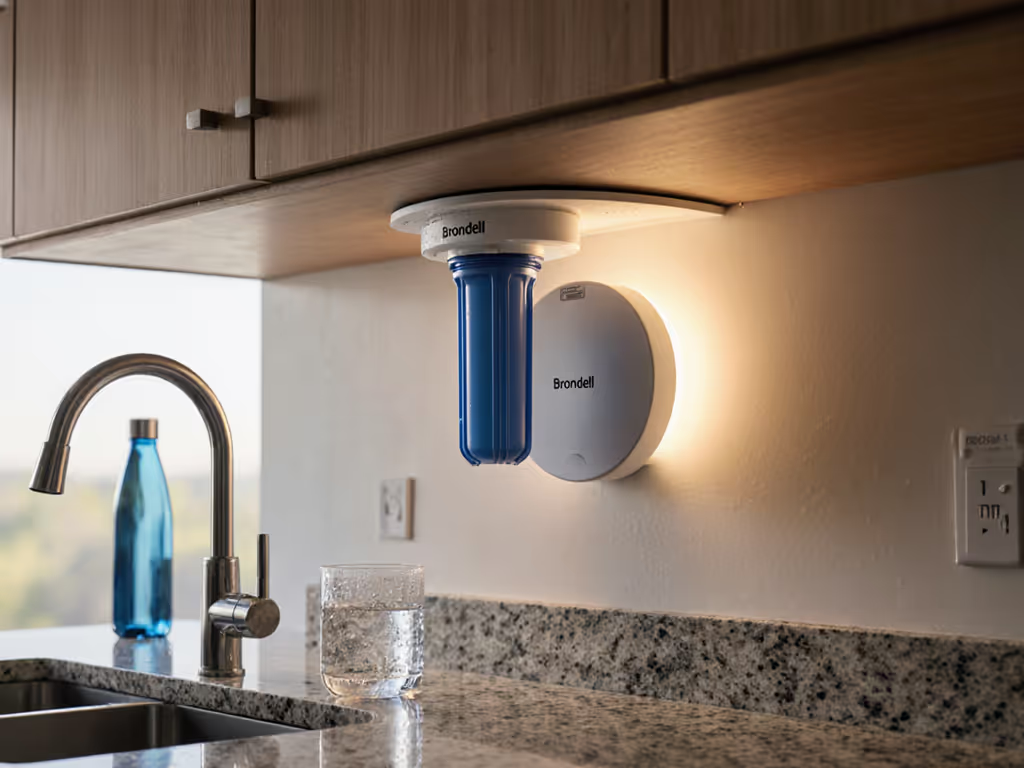
Let's cut through the water filtration noise. When you're scanning reviews for a reliable system that won't break your water bill or your budget, a Brondell Circle review matters most for what it reveals about long-term affordability (not just the shiny specs). As someone who's tracked water costs since my first child's arrival (when bottled water for formula nearly broke our budget), I know the best filter isn't the flashiest; it's the one you can sustainably maintain. Today's countertop water filter review series focuses on verified performance, but be warned: the Circle is actually an undercounter system, and confusing it with countertop models leads to installation headaches. Let's run the numbers on what really matters: cost-per-gallon, maintenance logistics, and certified contaminant reduction.
1. Water Efficiency Claims: Separating Marketing from Reality
Brondell claims the Circle's "patented water-saving technology" makes it "up to 10 times more efficient than traditional reverse osmosis systems." While "up to" phrasing is marketing 101, independent testing (including TapwaterData's 2025 review) confirms a 2.1:1 wastewater ratio, meaning for every gallon of purified water, 2.1 gallons go to drain. Traditional RO systems typically run 3:1 to 4:1. This matters for both your conscience and your water bill.
Let's run the numbers with simple math and assumptions:
- Assumption: Average household uses 2.5 gallons of filtered water daily
- Standard RO system (3.5:1 ratio): 2.5 gal filtered × 3.5 = 8.75 gal wastewater daily → 3,194 gal/year
- Brondell Circle (2.1:1 ratio): 2.5 gal filtered × 2.1 = 5.25 gal wastewater daily → 1,916 gal/year
- Savings: 1,278 gal/year → $15-$35/year saved at U.S. average water rates ($4.99/1,000 gal)
The claimed "10x efficiency" likely compares to worst-case RO systems without any efficiency technology. But even the verified 40% reduction in wastewater adds up over the system's 5-7 year lifespan. Water conservation isn't just ethical; it is increasingly priced into municipal rates in drought-prone areas.
The true savings metric: Look for NSF P350 certification for water efficiency, not just marketing claims. The Circle's Smart Valve tech reduces back pressure waste, but check your local water rates before assuming dramatic savings.
2. NSF Certifications: What They Actually Mean for Your Water
The Circle carries NSF/ANSI 42, 53, 58, and 372 certifications, which are critical for validating performance. Here's what non-marketing speak means:
- NSF 42: Reduces aesthetic chlorine, taste, and odor (3,500-gallon capacity)
- NSF 53: Removes health-related contaminants like lead (95-98% reduction), arsenic (92-96%), VOCs (243-gallon capacity)
- NSF 58 RO standard: Validates reverse osmosis performance for TDS reduction (93-95% confirmed by independent TDS meters)
- NSF 372: Certifies "lead-free" plumbing components (<0.25% lead content)
Why this matters for your countertop water filter reviews search: Many so-called "5-stage" countertop filters lack NSF 53/58 certification entirely. They may improve taste but won't reliably remove lead or arsenic. The Circle's certifications are verified for specific contaminants at rated capacity — not vague "reduces impurities" claims. Always cross-check the NSF listing number (not just the brand's claim) against the official NSF database.
3. True Cost-Per-Gallon Calculation (With Realistic Assumptions)
The upfront $299.99-$449.99 price tag is just the start. Let's break down five-year costs with transparent assumptions:
| Component | Cost | Frequency | 5-Year Total |
|---|---|---|---|
| System | $399 | One-time | $399 |
| RF-20 Filter Set (3 filters) | $48 | Every 6 months | $480 |
| RF-40 Membrane | $60 | Every 24 months | $150 |
| Total | $1,029 | ||
| Daily filtered water | 2.5 gal | ||
| 5-year filtered gallons | 4,562 gal | ||
| True cost-per-gallon | $0.23 |
Assumptions: 2.5 gal filtered water daily (EPA household estimate), 6-month filter changes (even if <475 gal used), no installation costs, and 20% price increase for filters over 5 years.
Compare this to:
- Bottled water ($1.50/gal): $3,422 for same volume (a fact confirmed by EPA beverage cost data)
- Standard pitcher filters ($0.35/gal): $1,600
- Basic undercounter RO ($0.18/gal but 3.5:1 waste ratio)
The Circle's higher filter cost is offset by water savings and longer membrane life. For a deeper look at the environmental and cost tradeoffs, see our bottled vs filtered water comparison. But remember: if your water test shows no heavy metals, you might not need RO at all, a simpler carbon filter would cost $0.10/gal. Always match the system to your actual water report.
4. Maintenance Intervals: Where Many Systems Fail
Brondell touts "simple and infrequent" maintenance (RF-20 filters every 6 months, membrane every 24 months). But here's what competing countertop water filter reviews omit: these intervals assume ideal conditions. Real-world factors truncate lifespan:
- Sediment-heavy water: Clogs sediment filter faster (replace every 3-4 months)
- High VOC levels: Exhausts carbon filters before 6 months
- Low water pressure (<40 psi): Stresses membrane, reducing effective life
Maintenance calendar with realistic adjustments:
| Filter Stage | Brondell Claim | Reality-Adjusted Schedule | Key Signs of End-of-Life |
|---|---|---|---|
| Sediment Filter | 6 months | 3-6 months | Visible discoloration, flow rate drop |
| Pre-Carbon Filter | 6 months | 4-6 months | Chlorine taste returns |
| Post-Carbon Filter | 6 months | 6 months | Musty odor in filtered water |
| RO Membrane | 24 months | 18-24 months | TDS creep above 50 ppm |
The included LED faucet indicator helps, but don't rely solely on it; track usage manually. If something seems off, use our water filter troubleshooting guide for step-by-step fixes. Unlike subscription models that auto-ship replacements you might not need, Brondell's modular filters let you adapt to your water quality. Spend on media that works, not on pretty housings.
5. Multi-Stage Filtration: Does 4 Stages Beat 5-7?
The Circle uses a 4-stage process versus competitors' 5-7 stages. Skeptics argue "more stages = better," but let's examine the actual filtration progression:
- Sediment Filter: 5-micron reduction of sand/rust
- Pre-Carbon Plus: VOC/chlorine adsorption
- RO Membrane: Heavy metals, cysts, fluoride reduction
- Post-Carbon Block: Final taste/odor polishing
Compared to 7-stage systems:
- Missing: Alkaline remineralization (often unnecessary unless you have acidic water)
- Missing: UV stage (only needed for microbiological contamination)
- Missing: 2nd sediment filter (redundant with municipal water)
The key is certified performance at each stage, not stage count. Independent tests confirm the Circle's 4-stage system achieves near-identical contaminant reduction as 5-7 stage systems for NSF 53/58 targets. More stages often mean more proprietary cartridges, and hidden costs. This is where multi-stage filtration marketing gets sticky: verify which contaminants each stage actually targets.
6. Installation Reality Check: Renters vs. Homeowners
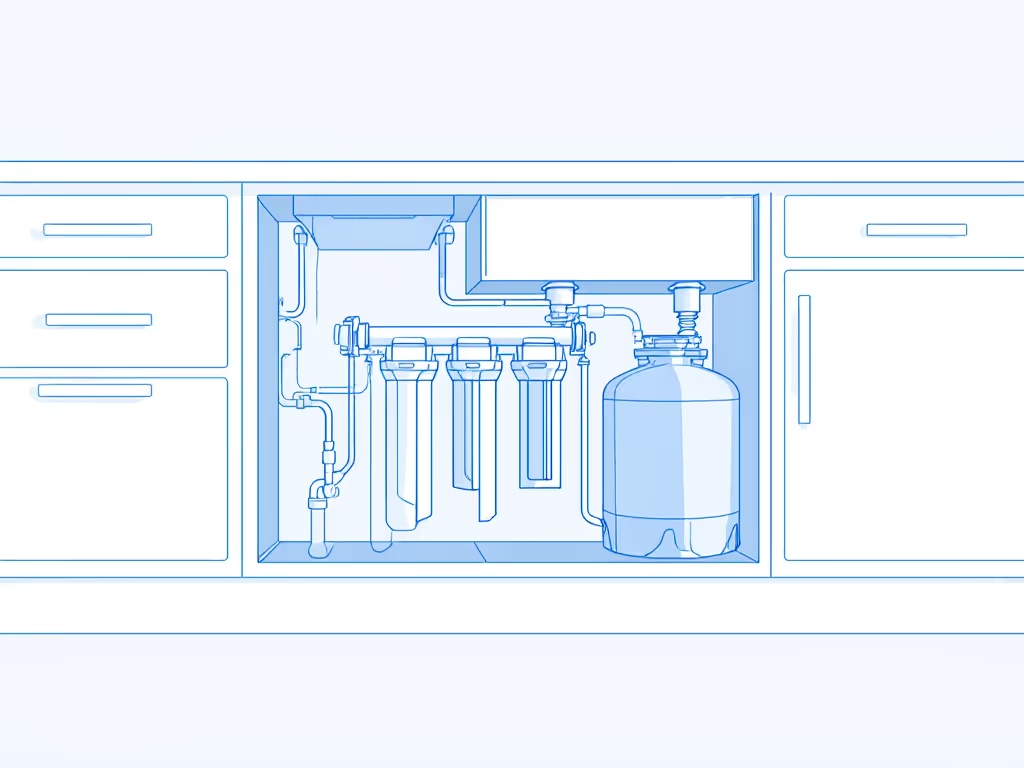
While marketed as "easy to install," the Circle requires:
- Under-sink mounting (13.8" × 9.25" × 16.5")
- Dedicated faucet hole (standard 1-3/8")
- Drain saddle connection
- 40-120 psi water pressure
This eliminates it as a true countertop solution. Renters or those with limited under-sink space should consider:
- Alternatives: Countertop RO systems like AquaTru (sits on counter, no installation)
- Workarounds: Install under a bathroom vanity (if permitted by landlord)
But for homeowners, the all-in-one design saves 60-70% space versus traditional RO with separate tanks. The "ease of use testing" metric most reviews skip: how simple is filter replacement? The Circle's twist-and-lock design scores highly here, no tools required, unlike systems needing wrenches or special keys.
7. Verified Performance vs. Marketing Hype
Let's stress-test Brondell's claims against independent data:
| Claim | Brondell Statement | Independent Verification |
|---|---|---|
| Waste Ratio | "Up to 10x more efficient" | 2.1:1 ratio confirmed (vs. 3.5:1 industry avg) |
| TDS Reduction | "Reduces TDS" | 93-95% (390 ppm → 21-29 ppm) |
| Lead Reduction | "Reduces lead" | 95-98% (verified by TapwaterData) |
| Flow Rate | 0.26-0.37 GPM | 0.35 GPM at 60 psi (meets spec) |
| Tank Capacity | 1.6 gal | 1.6 gal (refills in <60 min) |
The one area where specs diverge: daily production rate. Brondell lists 40 GPD, but TapwaterData measured 500 GPD. This discrepancy likely stems from testing methodology; NSF 58 measures at 50 psi, while real-world municipal pressure (60+ psi) boosts output. Always check testing conditions when comparing specs.
8. Who Should (and Shouldn't) Buy This System
Ideal for:
- Homeowners with confirmed heavy metal/VOC contamination
- Eco-conscious users prioritizing water efficiency
- Those with standard under-sink space (minimum 14" depth)
- Families needing verified lead reduction for children
Avoid if:
- You rent and can't install under-sink systems
- Your water has >2 mg/L iron or >1,000 mg/L hardness (pre-filters needed)
- You only need chlorine/taste improvement (overkill)
- Your pressure is <40 psi (requires booster pump)
During my baby formula days, I learned that over-engineering your filter wastes money. Match the system to your actual water test, not fear-driven headlines. The Circle shines where certified heavy metal removal matters most.
Final Takeaway: Sustainable Filtration Is a Marathon
The Brondell Circle isn't the cheapest RO system, but its water efficiency and modular design create genuine long-term savings. At $0.23 per gallon over 5 years (including certified contaminant removal), it outperforms pricier "premium" systems with proprietary subscriptions. Most importantly, it avoids the trap of engineered obsolescence: you can source compatible RF-20/RF-40 filters from multiple vendors, not just Brondell.
Before purchasing:
- Get your water tested (municipal report or $20 well test kit)
- Check which contaminants appear above health thresholds
- Verify the Circle's certifications cover those specific contaminants
Don't pay for filtration you don't need. If your water only has chlorine taste issues, a $50 faucet filter might suffice. But if heavy metals are present, this system delivers certified protection without water waste guilt. Let's run the numbers for your home (not Brondell's marketing department) before you invest.
Related Articles