Ultrafiltration Explained: What It Removes (and What It Doesn't)
By Nkechi Okafor • 19th Jan
For homeowners navigating boil-water advisories or well contamination concerns, ultrafiltration explained clearly is non-negotiable. Unlike chemical treatments, how ultrafiltration works relies on precise physical separation through specialized membranes, a critical distinction when safeguarding your household water. As a source-water analyst, I see recurring confusion between what this technology can and cannot remove. Let's cut through the noise with verified performance data, grounded in EPA and NSF/ANSI standards. Remember: Test first, then layer certified barriers based on your actual water profile, not marketing claims.
What Exactly Is Ultrafiltration?
Ultrafiltration (UF) is a pressure-driven membrane filtration process using semi-permeable barriers with pores sized between 0.01-0.1 micrometers (10-100 nanometers). This places it between microfiltration (larger pores) and nanofiltration/reverse osmosis (tighter pores) in the membrane spectrum. The core mechanism is size exclusion: particles larger than the pore size are physically blocked, while water and smaller dissolved substances pass through as permeate.
How Does Pore Size Technology Determine What Gets Removed?
The effectiveness of selective contaminant removal hinges entirely on the relationship between contaminant size and membrane pore dimensions. Here's what verified testing shows:
-
Effectively Removed (≥99.99% with intact membranes):
-
Bacteria (typically 0.2-5 microns; e.g., E. coli, Legionella)
-
Protozoan cysts (e.g., Giardia at 4-12 microns, Cryptosporidium at 2-5 microns)
-
Most suspended solids and turbidity
-
Viruses (partially; removal varies by type and membrane integrity. Many are 0.02-0.3 microns, overlapping with UF pore sizes. NSF P231 certification validates virus reduction claims.)
-
NOT Removed (pass freely through membrane):
-
Dissolved salts (sodium, calcium, magnesium)
-
Ions causing hardness or scaling
-
Most chemical contaminants (PFAS, pesticides, nitrates, arsenic)
-
Dissolved organic matter (tannins, some pesticides)
-
Chlorine, chloramines
This is why UF systems alone cannot address hard water scaling, chemical contaminants, or taste/odor issues from dissolved organics. Test first to confirm your water's specific hazard profile before selecting technology.
Common Misunderstandings About Ultrafiltration
"Does UF Remove Viruses Completely?"
Reality: Virus removal depends on two factors: membrane pore consistency (0.01-0.1 microns) and system integrity. Smaller viruses like norovirus (0.027-0.04 microns) may pass through some UF membranes. The CDC notes UF achieves "90-100% pathogen removal" but specifies this excludes all viruses. For comprehensive viral protection, pair UF with certified UV disinfection (NSF P231) or post-chlorination, exactly as we did during that flood-related boil notice where neighbors initially panicked. Evidence-based sequencing turned uncertainty into actionable protection.
"Can UF Replace Reverse Osmosis for Chemical Contaminants?"
Reality: No. UF's pore size technology targets particulates, not dissolved ions or molecules. RO membranes (0.0001 microns) remove dissolved salts, heavy metals, and most chemicals. If your water test reveals PFAS, arsenic, or nitrates, you'll need RO (NSF P473 or P231) or ion exchange, not UF. Confusing these is a costly error for health-conscious homeowners.
"Is UF Maintenance-Free Since It Uses No Chemicals?"
Reality: While UF operates without adding chemicals to the water stream, membrane fouling from organic matter or scaling requires periodic cleaning. Pretreatment (e.g., sediment filters) is essential for longevity, especially with well water or high-turbidity municipal supplies. For rural well owners, skipping this step risks rapid performance decline. Always match pretreatment to your source water's CCR or lab report.
How Ultrafiltration Fits Into Whole-Home Protection
UF excels as a layer in multi-barrier water purification systems, but never as a standalone solution for most households. Its niche is physical contaminant removal where:
- Municipal systems fail (e.g., after main breaks causing turbidity spikes)
- Well water shows bacterial contamination but low chemical risk
- Pre-treatment is needed before RO to extend membrane life
Optimal Layering Strategies
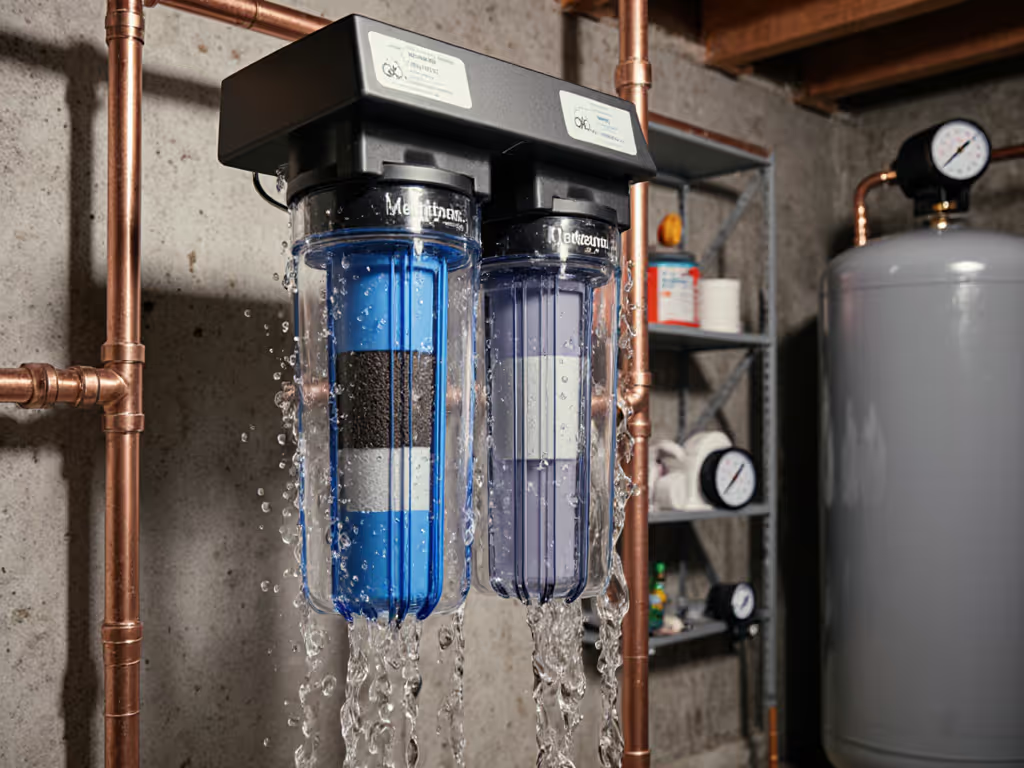
- For Municipal Water with Turbidity Spikes (e.g., aging infrastructure regions):
- Stage 1: Sediment pre-filter (5-micron)
- Stage 2: UF membrane (removes bacteria, cysts)
- Stage 3: Activated carbon (NSF 42/53) for chlorine, taste, VOCs
- For Rural Well Water Post-Test (e.g., confirmed coliforms):
- Stage 1: Iron/manganese pre-filter if needed
- Stage 2: UF membrane
- Stage 3: UV disinfection (certified NSF P231) for virus coverage
- Never skip the initial well test (scaling or iron can wreck UF membranes).
Critical Limitations to Know Before Installing
UF provides no protection against:
- Chemical contaminants (PFAS, pesticides, pharmaceuticals)
- Dissolved metals (lead, arsenic, copper)
- Hardness minerals (calcium, magnesium)
- Chlorine disinfection (reduces residual protection)
This is why comprehensive testing precedes any recommendation. During wildfire season in the West, I've seen homeowners install UF assuming it handles smoke-related organics, only to find dissolved compounds unchanged. Test first, then layer certified carbon (NSF 53) for those scenarios.
When Is Ultrafiltration the Right Choice?
Consider UF only if your water analysis confirms:
- Bacterial/protozoan contamination (e.g., positive coliform test)
- High turbidity (>1 NTU) from particulate matter
- No significant chemical or dissolved contaminant risks
For aging infrastructure zones (Northeast/Midwest), it's a reliable backup during boil notices. For well owners, it's a targeted solution after full panel testing rules out chemical hazards. But if your goal is removing arsenic in Arizona or PFAS in Michigan, look to certified RO or specialized media. If low water pressure is a constraint in your home, see our low-pressure filter solutions to avoid flow issues.
Final Verification Steps
Before trusting any UF system:
- Confirm NSF/ANSI 58 certification for the exact model (not just the brand)
- Verify virus reduction claims with NSF P231 documentation
- Match pre-filters to your water's TDS and turbidity levels
- Document flow rate at 40-60 PSI to ensure household needs are met
Related Articles