
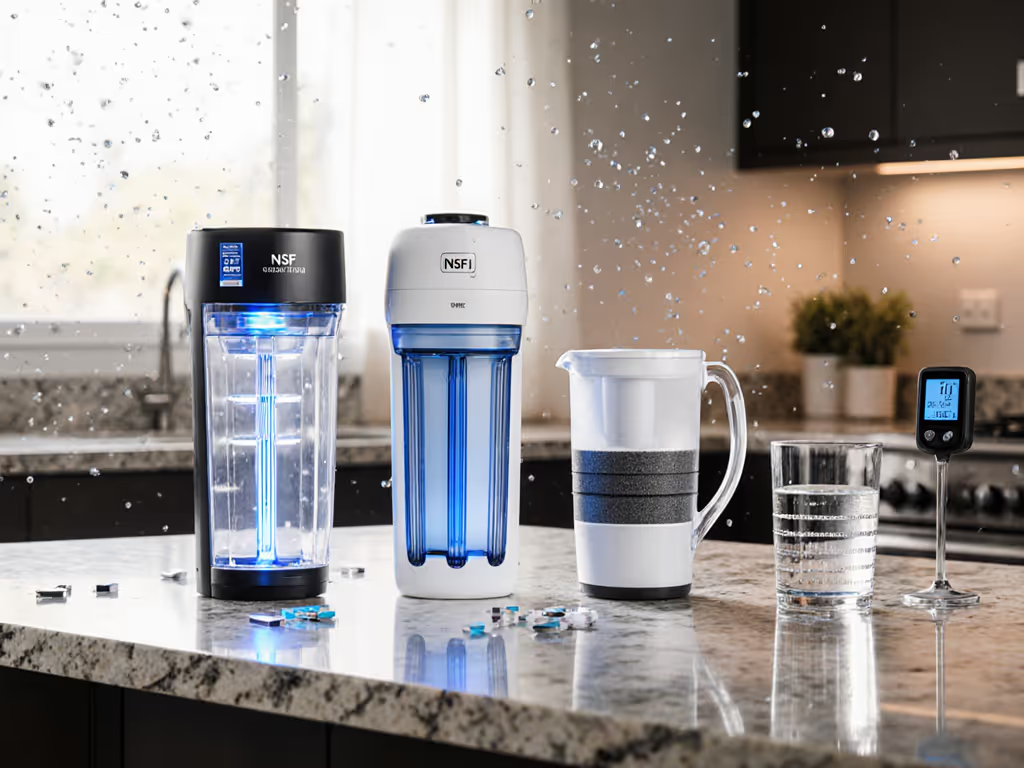
Best Microplastic Water Filter: Faucet Filters with Lab Data
By Samira Khan • 2nd Jun
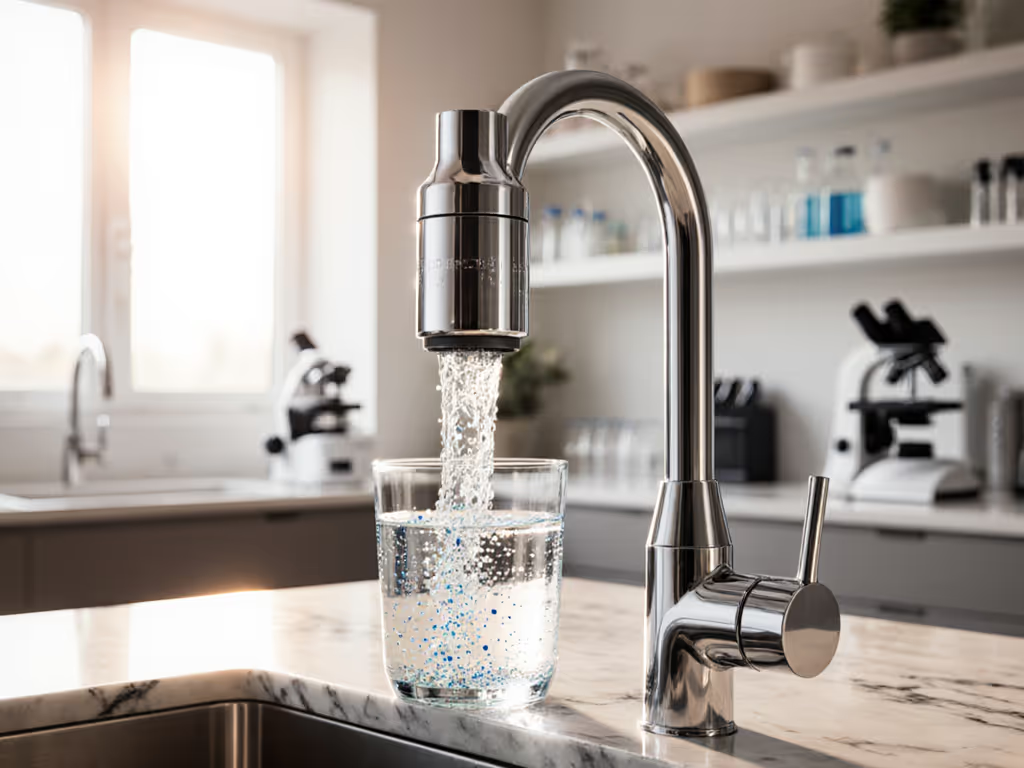
If you want a microplastic water filter you can live with day in, day out, a well-chosen faucet filter is often the most practical balance of performance, price, and zero-fuss installation.
You are not imagining the headlines: microplastics are now turning up in tap water, bottled water, and even human tissues.[3][6] One global study found plastic particles in about 81% of tap water samples, with U.S. samples at the higher end of the range.[7] Another analysis estimated that people ingest tens of thousands of microplastic particles per year through food, water, and air, depending on diet and bottled vs. tap habits.[6][7]
That's the anxiety side. The solution side is very concrete: a faucet filtration setup for microplastics with published lab data and a clear cost-per-gallon so you know exactly what protection you're getting and what you're paying for it.
Spend on media that works, not on pretty housings.
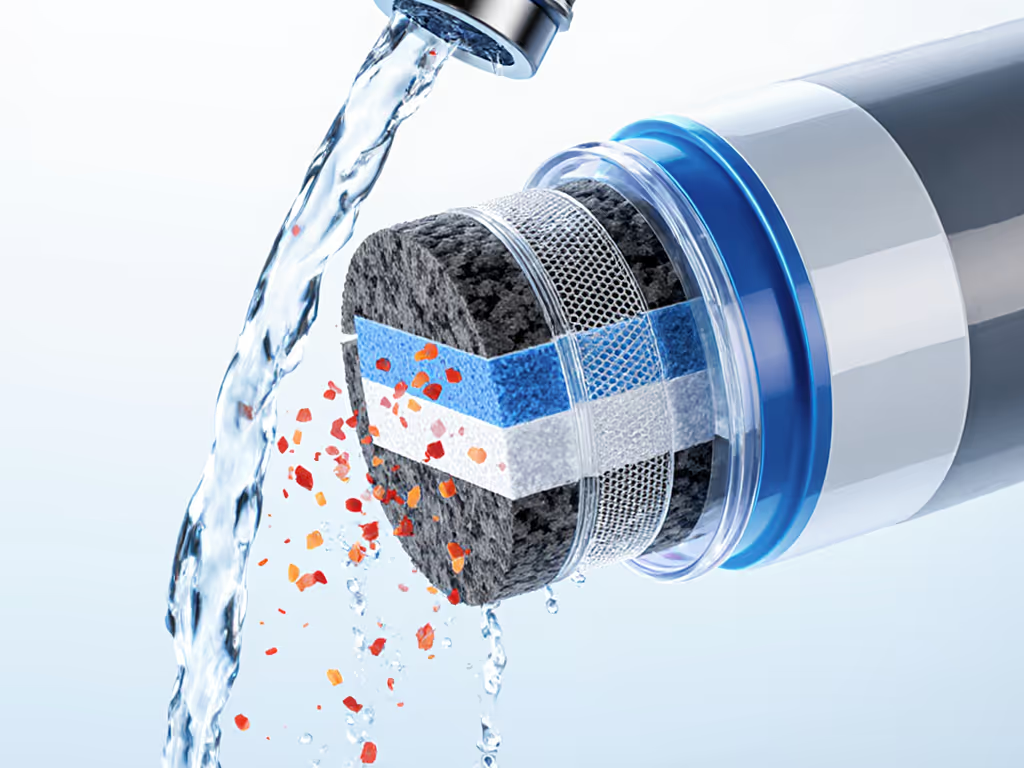
Below, I'll walk through 10 data-driven checkpoints to choose and maintain a faucet-mounted microplastic water filter where budget meets efficacy. I'll use simple math (with assumptions stated) so you can sanity-check any product claims against your own household's reality.
1. Microplastics 101: what your faucet filter is up against
Before picking a filter, it helps to understand the size and behavior of what you're trying to block.
What are microplastics? Microplastics are plastic particles smaller than 5 mm (about a chia seed) and often much smaller, down into the 1 micron (µm) range and below.[3][6] Sources include:
- Breakdown of larger plastic trash and litter[6]
- Synthetic clothing fibers released in laundry[6]
- Personal care products with microbeads[6]
- Industrial and wastewater discharge[6]
- Atmospheric fallout that eventually lands in water[6]
Studies have found microplastics in about 83% of global tap water samples and over 90% of bottled water in some surveys.[3][7] U.S. tap samples in one study averaged about 9.24 particles per liter, the highest of the countries tested.[7]
Nanoplastics are smaller still (below 1 µm) and are now being measured in bottled water at extremely high counts with new imaging methods.[3] Typical faucet filters are not tested down in this nanoplastic size range; they target the larger microplastic fraction.
Key takeaway for filters:
- A faucet filter with a 0.5 µm (or smaller) nominal rating and verified plastic particle removal can significantly reduce microplastics, but will not catch every nanoplastic.
- Real-world performance depends on flow rate, cartridge design, and maintenance, not just a micron number on the box.
2. Why a faucet filter is the practical microplastic water filter for most kitchens
There are many ways to chase microplastics: fridge filters, pitchers, under-sink systems, full reverse osmosis (RO), gravity filters, and portable devices.[1][3][5] For many households, a faucet filter hits a useful middle ground. If you're weighing pros and cons, see our guide to faucet filter limits for what NSF 42 does—and doesn't—cover.
Where faucet filters shine for microplastics:
- Always-on at the tap for drinking, cooking, coffee, and baby formula
- No drilling or permanent changes, usually renter and HOA friendly
- Higher flow than most pitchers
- Easy to pair with an under-sink system later if you upgrade
Compared with RO systems, faucet filters:
- Don't produce reject water (so no "waste guilt" on that front)
- Are cheaper up front and simpler to maintain[5]
- Usually remove less than RO overall (especially for dissolved contaminants) but can still be strong for particulate removal like microplastics
If you later decide to install RO or a big under-sink system, a faucet-mounted unit can become a pre-filter for sediment and plastic particles, extending the life of more expensive media.
3. How to read microplastic removal data (and avoid marketing fog)
The most important part of choosing a faucet filtration for microplastics system is understanding how microplastic removal data is actually measured.
3.1 Certifications that matter
For microplastics, the key independent standard you'll see is:
- NSF/ANSI 401 (also referenced by WQA or IAPMO for certification)
- This standard covers "emerging contaminants," including a microplastic surrogate test.
- Filters certified under 401 for microplastics must reduce 0.5 µm plastic particles (often polystyrene spheres) by at least 85% at their rated flow and capacity.[2]
You will often see NSF/ANSI 42 and 53 alongside 401:
- NSF/ANSI 42 – aesthetic: chlorine, taste/odor, some particulates
- NSF/ANSI 53 – health: lead, cysts, some heavy metals
For microplastic focus, 42 and 53 alone aren't enough; you want explicit microplastic or particulate reduction claims with supporting lab data, ideally via NSF/ANSI 401.[2][6]
3.2 Why not trust every "microplastic" label?
Consumer testing has found that performance can vary wildly:
- In one independent review, one filter removed all detectable microplastic particles, another reduced them by about 80%, and a third by 36%.
- A different pitcher actually increased plastic particles to over 400 per liter, likely due to shedding from its own components.[7]
This is why certification and lab reports matter. Marketing labels like "removes microplastics" without:
- Test particle size (e.g., 0.5–1 µm),
- Reduction percentage, and
- Gallons/flow rate used in testing
... are not enough for a data-driven purchase.
3.3 No home test (yet)
There are no simple home tests for microplastics today.[6] Utilities in some regions (like parts of California) are beginning to monitor microplastics in drinking water, and specialized labs can analyze samples, but that's not a quick strip test.[6]
So for now, you are choosing a faucet filter based on:
- Independent certifications and lab reports
- Micron ratings (with skepticism)
- The manufacturer's rated capacity and flow
- Whether you can maintain it on time
4. Faucet Filter Profile A: Certified microplastic specialist (best overall)
This profile is the "gold standard" faucet filter for microplastics: independently certified for microplastic reduction, with transparent performance data and reasonable cost of ownership.
What to look for
- NSF/ANSI 401 certification (WQA or IAPMO) with a line item for microplastics
- At minimum, NSF/ANSI 42 for chlorine, taste, and odor
- Preferably NSF/ANSI 53 for lead and cysts
- A published test result showing:
- ≥85% reduction of 0.5 µm plastic particles at rated flow and capacity[2]
- Test lab and report date
Typical construction
- Sediment pre-filter (to keep larger particles and rust off the main media)
- Compressed carbon block (for adsorption of chemicals plus fine particulate capture)
- Flow diverter at the faucet so you can switch between filtered and unfiltered water
Rough cost-of-ownership math
Assumptions:
- Cartridge price: $40
- Rated life: 300 gallons (common for higher-end faucet filters)
- Household filtered use: 2 gallons/day (drinking + cooking)
Math:
- 300 gallons ÷ 2 gallons/day ≈ 150 days per cartridge
- $40 ÷ 300 gallons ≈ $0.13 per gallon
- That's about $0.26/day at 2 gallons/day
For many families, that's less than a single disposable water bottle, while also avoiding bottled water's higher average microplastic load.[3][7]
Who this profile fits
- Households willing to pay a bit more upfront and per cartridge for hard data
- People mixing baby formula or supporting immune-compromised family members
- Anyone who wants a faucet filter to be their primary microplastic defense, not just a taste-improver
When my own family hit the "new baby, panicking over bottled water costs" phase, this is the profile that calmed the spreadsheets: a faucet-mounted unit with clear microplastic and lead data, and a simple calculator to show cost-per-gallon.
5. Faucet Filter Profile B: High-capacity workhorse (best for families and heavy use)
If you run a busy kitchen, cook at home often, or fill large jugs from the tap, you need a faucet filter that prioritizes capacity and flow without giving up too much on microplastic removal.
What to look for
- Higher capacity cartridges: 400-700 gallons
- Lab data for fine particulate removal (ideally 0.5–1 µm) even if not explicitly branded as "microplastic"
- Certifications for NSF/ANSI 42 and 53 at full capacity, not just at the start of life
- Sturdy metal or reinforced plastic housing to handle constant use
Performance trade-offs
These workhorse units may:
- Emphasize chlorine, taste/odor, and particulate reduction over exotic contaminants
- Offer slightly lower microplastic reduction percentages than the specialist profile, especially at end-of-life
However, if the lab data still shows strong plastic particle removal across the cartridge's rated life, this can be a more realistic choice for a large household.
Rough cost-of-ownership math
Assumptions:
- Cartridge price: $55
- Rated life: 600 gallons
- Household filtered use: 4 gallons/day (larger or very cooking-heavy household)
Math:
- 600 gallons ÷ 4 gallons/day = 150 days per cartridge
- $55 ÷ 600 gallons ≈ $0.09 per gallon
- At 4 gallons/day, that's $0.36/day
Compared with Profile A, your cost per gallon is lower, but you must confirm via data that microplastic performance stays adequate at higher throughputs.
Who this profile fits
- Families of 4+ who cook and drink from the tap daily
- Small shared homes or roommate setups
- Anyone who doesn't want to be swapping cartridges every 2–3 months
The best filter is the one you can afford to maintain, sustainably.
Profile B often wins on that criterion.
6. Faucet Filter Profile C: Rental-friendly with easy on/off (best for apartments)
Renters often need flexible installation and the ability to restore the faucet to its original state quickly.
What to look for
- Tool-free faucet adapters that work with standard aerators
- A sturdy diverter valve so you can flip between filtered and unfiltered quickly
- Compact body that doesn't overload a small, older faucet
- Lab data indicating fine particulate reduction (0.5–1 µm), and at least NSF/ANSI 42 certification
Microplastic performance expectations
Many rental-friendly faucet filters are designed first for convenience and taste, then for higher-end contaminant removal. You want to narrow the field to those that:
- Provide a micron rating for particulate filtration
- Offer independent testing data for plastic particle removal or microplastic surrogate testing
If you can't find independent microplastic removal data, you're back in marketing territory, and in that case I would treat the filter as a taste/odor upgrade, not your primary microplastic shield.
Rough cost-of-ownership math
Assumptions:
- Cartridge price: $25
- Rated life: 200 gallons
- Household filtered use: 1.5 gallons/day (light cooking plus drinking)
Math:
- 200 gallons ÷ 1.5 gallons/day ≈ 133 days per cartridge
- $25 ÷ 200 gallons = $0.125 per gallon
- At 1.5 gallons/day, that's ~$0.19/day
For a small apartment, that's typically cheaper than ongoing bottled water, with much less plastic waste and, if the lab data checks out, better microplastic control.[3][7]
Who this profile fits
- Renters who cannot alter plumbing
- People who move frequently and want something they can pack and reinstall
- Anyone in older buildings with uncertain pipe history, who wants an easy win at the tap
7. Faucet Filter Profile D: Budget-conscious with transparent specs (best under tight budgets)
Sometimes you just need "better than nothing" protection that still respects the monthly budget. The key is to avoid false economies where you save a few dollars upfront but get no verified microplastic removal at all.
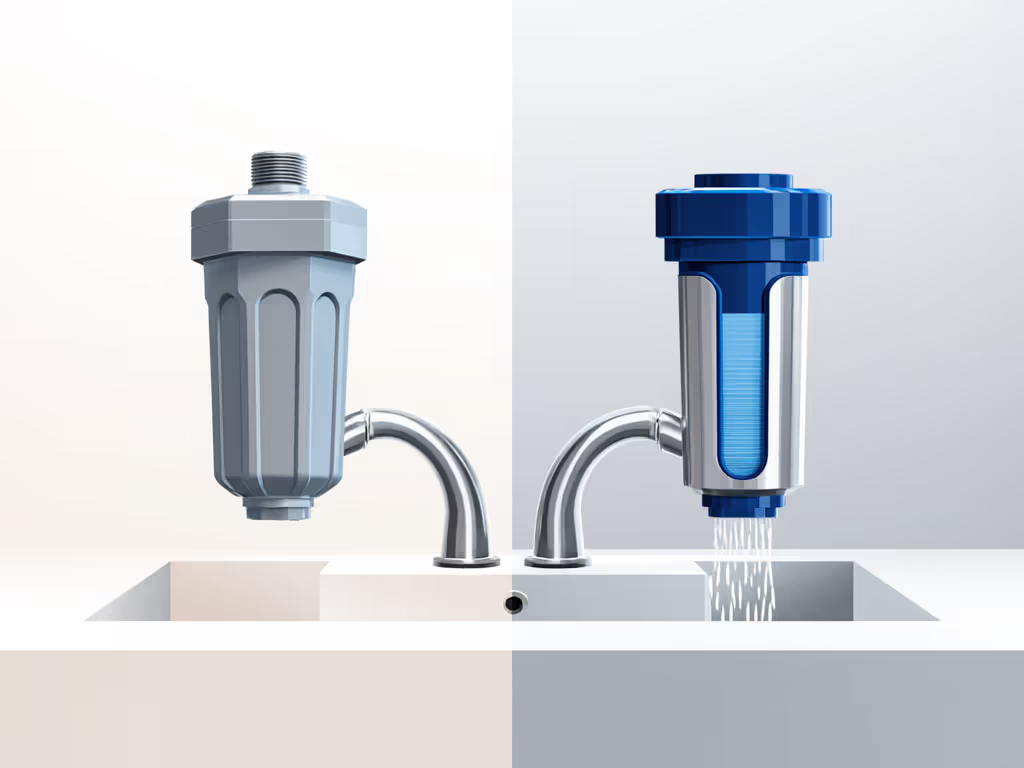
What to look for
- At least NSF/ANSI 42 certification for particulate reduction and chlorine
- A published micron rating for particulate (aim for ≤1 µm nominal)
- Any available lab report showing percentage reduction of fine particles at rated flow
You may not get 401-level microplastic certification in the lowest price tier, but some budget faucet filters still publish credible lab results for fine sediment and particulate removal.
Rough cost-of-ownership math
Assumptions:
- Cartridge price: $18
- Rated life: 150 gallons
- Household filtered use: 1 gallon/day
Math:
- 150 gallons ÷ 1 gallon/day = 150 days
- $18 ÷ 150 gallons = $0.12 per gallon
- At 1 gallon/day, ≈ $0.12/day
Notice that the per-gallon cost here is not hugely different from mid-tier filters. Where you may be compromising is on:
- Breadth of contaminants addressed
- Strength and documentation of microplastic reduction
Who this profile fits
- Students, single occupants, or tight-budget households
- As a temporary step while you save for a better-verified system
- Secondary taps (e.g., guest units, office sinks) where microplastics are a concern but not the primary focus
If you go this route, keep expectations realistic: you're aiming for some reduction in plastic particles, better taste, and the ability to upgrade later.
8. How faucet filters compare to pitchers, under-sink, and RO for microplastics
To sanity-check your faucet choice, it helps to see where it sits in the wider landscape.
Faucet filters vs. pitchers
- Pitchers can be effective if they have ceramic or fine carbon block media and proper certification, but many do not publish microplastic data.[1][2] See our Brita vs PUR vs ZeroWater test for side-by-side performance data.
- Some pitcher designs have been found to shed plastic, increasing microplastic counts in the treated water.[7]
- Faucet filters avoid the "jug handling" and usually offer higher flow and capacity, making it easier to use filtered water for cooking as well as drinking.
Faucet filters vs. under-sink systems
- Under-sink systems (non-RO) can pack in more media, offering multi-stage sediment + carbon + specialty media that may perform very well for microplastics when designed with tight enough particulate control.[5]
- They require more installation effort, sometimes drilling, and are less renter-friendly.
- A good under-sink system with a 0.5 µm pre-filter and carbon block is often a step up from faucet filters for broad contaminant control, but may be overkill for some renters.[5]
Faucet filters vs. reverse osmosis (RO)
- RO membranes are typically rated around 0.0005 µm, far smaller than most microplastics.[5] That makes RO extremely effective for both microplastics and many dissolved contaminants.
- Downsides: higher upfront cost, wastewater production, and more complex maintenance.[5] If you're considering RO, compare options in our low-waste under-sink RO guide for tight spaces and efficiency.
- For households truly anxious about PFAS, heavy metals, and microplastics together, RO is often the top choice, but a strong faucet filter can still be a valuable first step or upgrade.
In simple terms: a faucet filter is not RO, but it's often a major improvement over doing nothing and can be installed in under an hour without tools.
9. Cost-of-ownership math: putting microplastic protection on a budget
Let's pull the thread on total cost over time, since hidden cartridge costs are where many people feel burned.
Step 1: Estimate your daily filtered volume
Count how many 8–16 oz glasses of water you pour plus cooking use:
- Light use: 1-1.5 gallons/day
- Moderate family use: 2-3 gallons/day
- Heavy cooking or shared housing: 4+ gallons/day
Step 2: Use the simple formula
For any faucet filter, compute:
[\text{Cost per gallon} = \frac{\text{Cartridge price}}{\text{Rated capacity in gallons}}]
Then:
[\text{Daily cost} = \text{Cost per gallon} \times \text{Gallons/day}]
And:
[\text{Days per cartridge} = \frac{\text{Rated capacity}}{\text{Gallons/day}}]
Example comparison
Assume you use 2 gallons/day and are comparing three cartridges:
- Filter X: $25, 150 gallons
- Cost/gal = $25 / 150 = $0.17/gal
- Days per cartridge = 150 / 2 = 75 days
- Filter Y: $40, 300 gallons
- Cost/gal = $40 / 300 = $0.13/gal
- Days per cartridge = 300 / 2 = 150 days
- Filter Z: $55, 600 gallons
- Cost/gal = $55 / 600 = $0.09/gal
- Days per cartridge = 600 / 2 = 300 days
Filter Z looks "expensive" at the store, but costs about half as much per gallon as Filter X.
If Filter Z also has strong, independent microplastic removal data, it's the better choice where budget meets efficacy.
Step 3: Match performance tier to budget
- If you can afford a microplastic-certified faucet filter (Profile A or B) and keep up with cartridge changes on schedule, that's ideal.
- If not, choose the most transparent, independently tested unit you can and plan a future step-up when finances allow.
Remember: an affordable filter you replace on time beats a "hero" filter that sits in your cart because refills are too expensive.
10. Action plan: picking and maintaining your faucet filtration for microplastics
Let's turn this into a concrete 15-minute plan.
Step 1 (5 minutes): Clarify your constraints
Answer these quickly:
- Are you renting or owning?
- Renting → favor Profiles C or A (non-invasive faucet install).
- Owning with long-term plans → consider A or B, and think about an under-sink or RO upgrade later.
- How many people rely on this tap daily?
- 1-2 → lower capacity OK, but verify microplastic data.
- 3-5 → look for high-capacity cartridges and workhorse designs.
- What scares you more than microplastics?
- If lead or PFAS are top of mind, prioritize filters with relevant NSF/ANSI 53 or 401 claims in addition to microplastics.[2][6] For verified options, see our PFAS filters ranked by certified performance.
Step 2 (5 minutes): Demand hard data
For any faucet filter you're considering, look for:
- Certification logos (NSF/ANSI 42/53/401; or WQA/IAPMO equivalents)
- A spec sheet that spells out:
- Test particle size (e.g., 0.5 µm polystyrene)
- % reduction for microplastics or fine particulates
- Rated capacity (gallons) and flow rate used in testing
If the brand cannot show you any independent lab results and only uses vague language ("helps reduce microplastics"), treat it as unverified.
Step 3 (5 minutes): Set your maintenance calendar
Once you choose, do three things immediately:
- Write the installation date on the cartridge with a marker.
- Use the formula from Section 9 to calculate days per cartridge for your household.
- Add a reminder to your phone/calendar 2-3 weeks before that date.
If the filter has a built-in indicator (timer, color change, or app), treat it as a backup, not your only system. Actual use often exceeds the generic assumptions built into those indicators.
If you take nothing else from this guide, let it be this: Spend on media that works, not on pretty housings. A faucet-mounted microplastic water filter with clear lab data, a realistic maintenance plan, and a cost-per-gallon you're comfortable with will do far more for your household than any glossy, under-documented gadget. Focus on certifications, particle size and reduction percentages, and a replacement schedule that fits your routine, and you'll have turned a messy, global problem into a manageable, tap-level solution.
Related Articles
Agricultural Runoff Filters: Proven Pesticide Removal
Choose a home filtration setup that truly reduces pesticides from farm runoff with a test-first plan: understand the five factors that drive removal, compare lab-verified systems, and budget for replacements. Pair sediment pre-filtration and catalytic carbon, control flow rates, and set a maintenance schedule that sustains protection.
Fluoride vs Arsenic Filters: NSF Verified Comparison
Learn which NSF/ANSI certifications actually prove fluoride and arsenic reduction (58 for fluoride; P231/P473 for arsenic) and why many popular pitchers don’t qualify. Use the audit checklist - verified reduction at rated flow, waste ratio, remineralization, and arsenic III pre-oxidation - to choose a system matched to your water.